
Update Date:
What is Microsoft Fabric Data Agent?
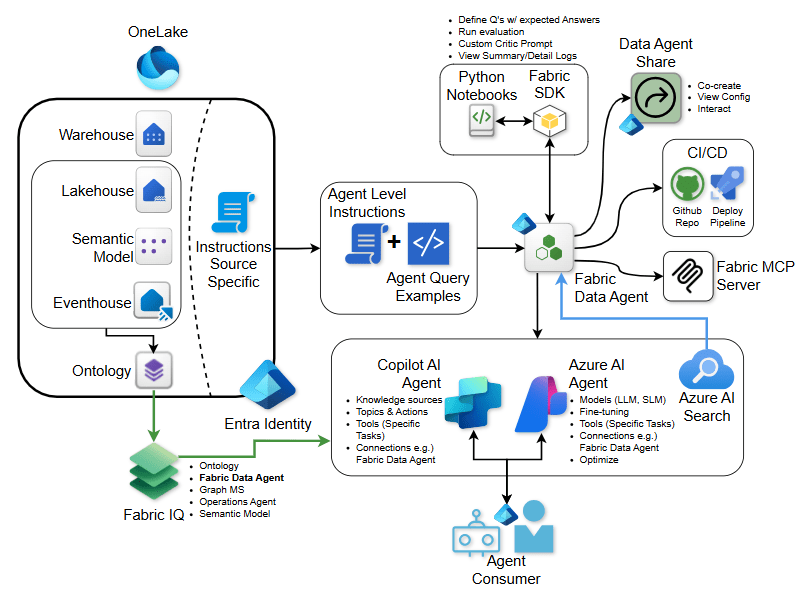
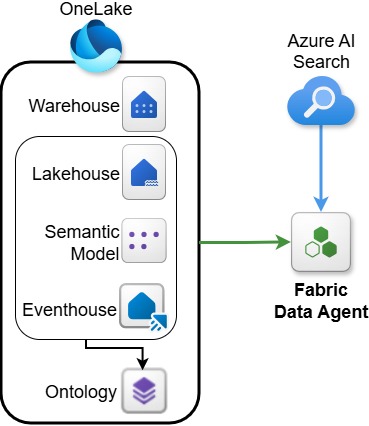
Microsoft Fabric Data Agent is an AI-powered conversational system that enables users to interact with enterprise data using natural language queries, eliminating the need for complex SQL, DAX, or KQL expertise (Microsoft Learn). Fabric data agents reached general availability at FabCon in March 2026. The underlying orchestration has since moved off the OpenAI Assistants API which OpenAI is retiring on August 26, 2026 and moving onto the OpenAI Responses API, with the data agent’s Model Context Protocol (MCP) endpoint now the recommended way to query it programmatically (Microsoft Learn). The agent identifies relevant data sources and generates validated queries across lakehouses, warehouses, Power BI semantic models, KQL databases, and ontologies (Microsoft Learn).
Core Capabilities
The Data Agent enforces read-only access to all data sources while respecting Row-Level Security (RLS) and Column-Level Security (CLS) policies Microsoft Learn. Recent updates expanded support to include mirrored databases, SQL databases, and unstructured data through Azure AI Search custom indexes Microsoft Fabric.
Integration with Microsoft Copilot
Data Agents integrate directly with Microsoft Copilot Studio, enabling custom AI agents to leverage enterprise data through agent-to-agent collaboration Microsoft Learn. This integration enables seamless deployment to Microsoft Teams, allowing business users to receive data-driven answers without leaving their chat environment Microsoft Fabric.
The integration process requires:
- Publishing the Data Agent in Microsoft Fabric with a detailed description Microsoft Learn
- Both services must be on the same tenant with matching account access Microsoft Learn
- Users need at least read access to both the Data Agent and underlying data sources Microsoft Learn
Note: the integration between Fabric data agents and Copilot in Power BI is scheduled to retire on August 26, 2026. This does not mean Fabric data agents are going away, but it reflects a shift in how conversational analytics is surfaced across Microsoft’s ecosystem, with MCP-based access points taking on a larger role. If you’re integrating through Copilot in Power BI today, plan to move to the MCP endpoint or Copilot Studio integration ahead of that date.
Integration with Microsoft Foundry
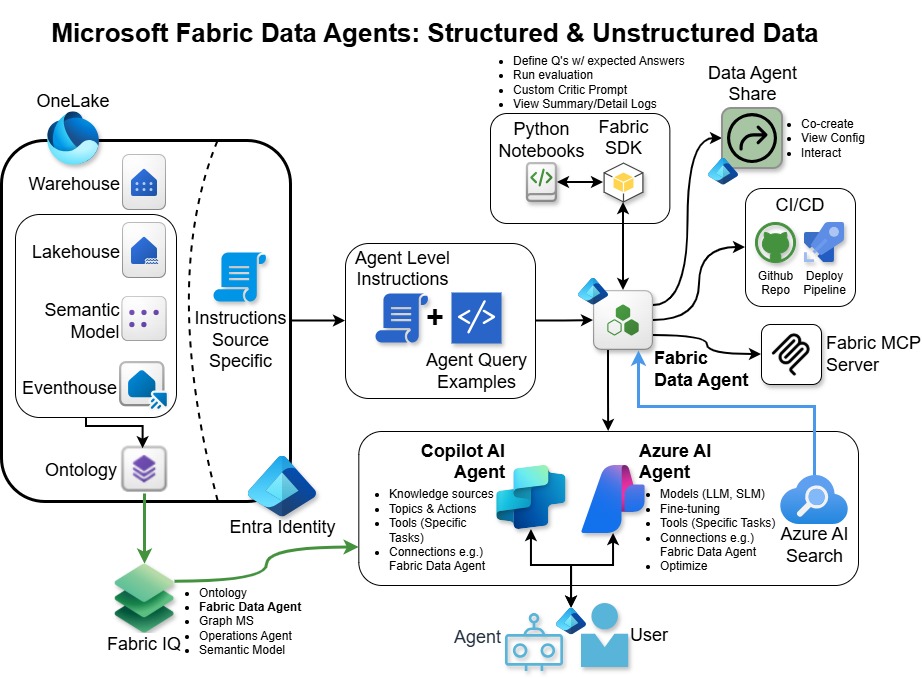
Data Agents connect to Microsoft Foundry Agent Service using workspace and artifact IDs from published endpoints, enabling agents to query enterprise data with Identity Passthrough authorization (Microsoft Learn). Foundry IQ, now generally available, has grown into a managed knowledge layer that unifies Work IQ, Fabric IQ, Azure SQL, File Search, and MCP sources behind a single, SLA-backed retrieval endpoint for the Foundry IQ MCP server so agents no longer need to know which data source to call for a given task. A companion component, Web IQ, adds real-time context from the open web with sub-165ms latency and zero data retention, grounding agents in current external information without introducing a compliance exposure in your tenant.
Foundry IQ automatically enforces Purview-based security on each agent call, ensuring context remains accurate, compliant, and up-to-date. Agents built in Microsoft Foundry can access Fabric Data Agents through hosted MCP server endpoints, enabling AI systems in VS Code and other environments to securely connect to enterprise knowledge (Microsoft Fabric).
Fabric IQ: The Semantic Intelligence Layer
Fabric IQ is part of Microsoft IQ, the enterprise intelligence layer of the Microsoft stack, where it works alongside Work IQ, Foundry IQ, and Web IQ — Fabric IQ specifically provides context on business entities and data (Microsoft Learn). It brings three layers of business context together: unified data through OneLake, business intelligence through Power BI semantic models, and operational intelligence through ontologies, delivered through two core items in the Fabric IQ workload — ontology (preview) and semantic model (Microsoft Learn).
Ontology (preview) defines core business entities, relationships, properties, rules, and actions, and can be queried directly using natural language through the NL2Ontology query layer, which converts business questions into structured queries (Microsoft Learn). Organizations can jumpstart ontology creation by generating it directly from an existing Power BI semantic model, keeping business language and KPIs consistent across reports, agents, and applications (Microsoft Learn).
Data agents and operations agents are both items within the Fabric IQ workload: data agents create virtual analysts that answer natural language questions grounded in semantic models and ontologies and can be published across Microsoft 365, Foundry, and Copilot Studio, while operations agents monitor real-time data and recommend or trigger governed business actions based on the same shared business concepts (Microsoft Learn).
Key Benefits
- Democratized Access: Non-technical users can ask questions in plain language and receive context-rich answers without understanding data structures or query languages Microsoft Learn
- Multi-Agent Orchestration: Connected agents can delegate tasks and collaborate across systems to achieve complex business goals Microsoft Fabric
- Enterprise Security: Microsoft-managed Azure OpenAI handles authentication automatically, with data access running under user identity and workspace permissions Microsoft Learn
- Real-Time Intelligence: Operations Agents in Fabric, which reached general availability at Build 2026, continuously monitor business conditions, evaluate trade-offs, and automatically take actions to advance desired outcomes across pipelines, capacities, and Power BI workspaces (Microsoft Fabric)
This integrated ecosystem positions Microsoft Fabric Data Agent as a central component in Microsoft’s unified intelligence platform, bridging data platforms with conversational AI capabilities while maintaining enterprise-grade governance and security.





Leave a Reply