Updated Date:
For two decades my job has been the same problem in different clothes: take complex, messy information and turn it into something an organization can act on. Warehouses, pipelines, analytics platforms, and now AI. When I sat down with the exam blueprint, I kept recognizing old concepts with new names. Orchestration. Contracts. Data quality. Observability.
This post is my take on what it took to pass, where my data background carried me, and where it didn’t.
Why I chose this certification
I picked this exam because it tests design judgment, not trivia. That’s the same skill that separates a data platform that survives production from one that doesn’t.
Enterprise data management has had decades to agree on what “production-ready” means. AI engineering is still writing that vocabulary. A certification built around realistic architectural tradeoffs felt like a way to prove I could make sound calls in the new world, not just talk about it.
Anthropic’s own framing sold me: candidates have to show practical judgment about architecture, configuration, and tradeoffs in production, not just conceptual knowledge. For anyone who has designed enterprise data systems, that will feel familiar. It is not a “read the docs and pass” exam. It rewards people who have built things.
How I prepared
My prep came down to three things: the official study guide, real projects, and deliberately practicing the areas that weren’t native to me.
- Started with the Anthropic Academy study guide. I mapped every objective to something I had already built or needed to build. Anything I couldn’t point to became a to-do.
- Learned by shipping. I applied Claude to actual data and analytics work: (schema-aware extraction from semi-structured documents, an MCP server over a warehouse, Claude Code in a dbt repo). Nothing locks in a concept like debugging it.
- Targeted my gaps. Structured output and tool design came naturally, since they’re data modeling and API contracts. Claude Code configuration / the Agent SDK took the most deliberate practice.
All in, I spent about 20 hours preparing. Anthropic recommends 6+ months of hands-on experience, and I think that’s fair. If you’ve been using Claude on real data problems, you have more of that experience than you think. Creating the demos in the Academy study guide will advance your experience greatly.
The exam through a data lens
The exam’s five domains read like a data architect’s career, translated. Every scenario asked the question I’ve asked for years: given these constraints, what’s the reliable design?
| Domain | Weight | What it felt like to a data architect |
|---|---|---|
| Agentic Architecture & Orchestration | 27% | Pipeline orchestration and ETL workflow design. Who does what, in what order, and what happens when a step fails. |
| Claude Code Configuration & Workflows | 20% | Developer tooling, CI/CD, and DataOps. CLAUDE.md files, Agent Skills, and plan mode are team standards, just versioned differently. |
| Prompt Engineering & Structured Output | 20% | Data modeling and schema design. JSON schemas and few-shot examples are contracts for unstructured input. |
| Tool Design & MCP Integration | 18% | API design and data contracts. A good MCP tool is a well-documented interface with clear inputs and outputs. |
| Context Management & Reliability | 15% | Data quality, error handling, and observability. Context is a finite resource you govern, like any other. |
The scenarios assumed hands-on experience with:
- Multi-agent orchestration with the Claude Agent SDK: subagent delegation, tool integration, lifecycle hooks
- Configuring Claude Code for teams with CLAUDE.md, Agent Skills, MCP servers, and plan mode
- Designing MCP tool and resource interfaces for backend systems
- Reliable structured output through JSON schemas, few-shot examples, and extraction patterns
- Managing context across long documents, multi-turn conversations, and agent handoffs
- Putting Claude into CI/CD for code review, test generation, and PR feedback
- Escalation and reliability calls: error handling, human-in-the-loop, and self-evaluation
What I’d tell the next data person
Your background is an advantage. Lean on it, then close the gaps with hands-on work.
- Translate, don’t memorize. When a concept feels new, find its data equivalent. A subagent handoff is a pipeline stage. A tool schema is a data contract.
- Think in failure modes. The best answer is usually the one that fails safely, not the clever one. You already know this from production data.
- Build before you study. Stand up an MCP server, configure Claude Code on a real repo, force structured output from messy documents. The exam rewards scar tissue.
- Respect context like storage. It is finite and it costs money. Decide what goes in, what gets summarized, and what stays out.
From pipelines to context windows
Language models are a new data processing layer, and this exam confirmed that the instincts behind good data architecture carry straight over. If you’ve spent your career making data trustworthy, you’re closer to Claude-ready than you think.
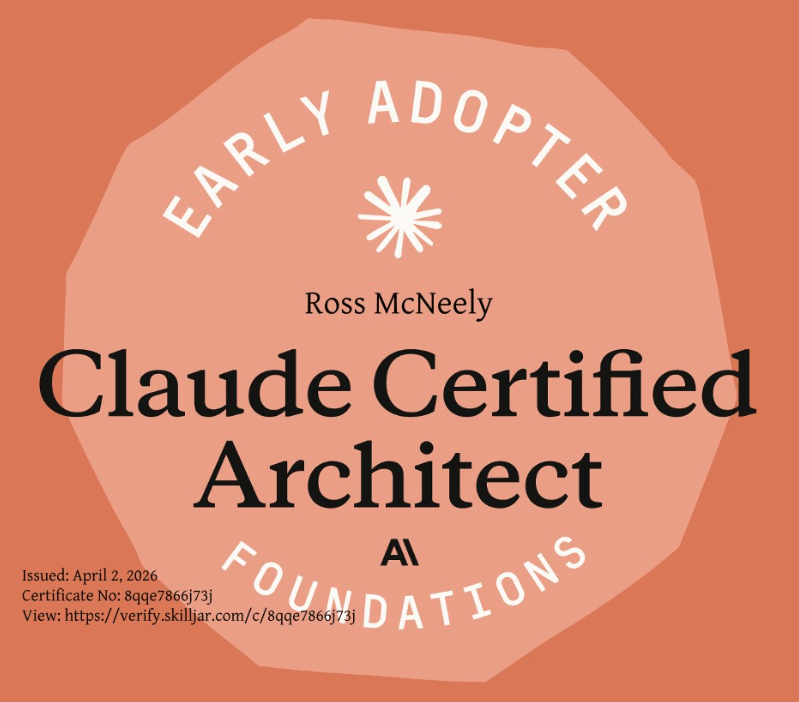
Certification Link: Certificate for Claude Certified Architect – Foundations Certification
Exam Study Guide Link: Claude Certified Architect – Foundations | Anthropic Academy



Leave a Reply