
What is Microsoft Fabric Data Agent?
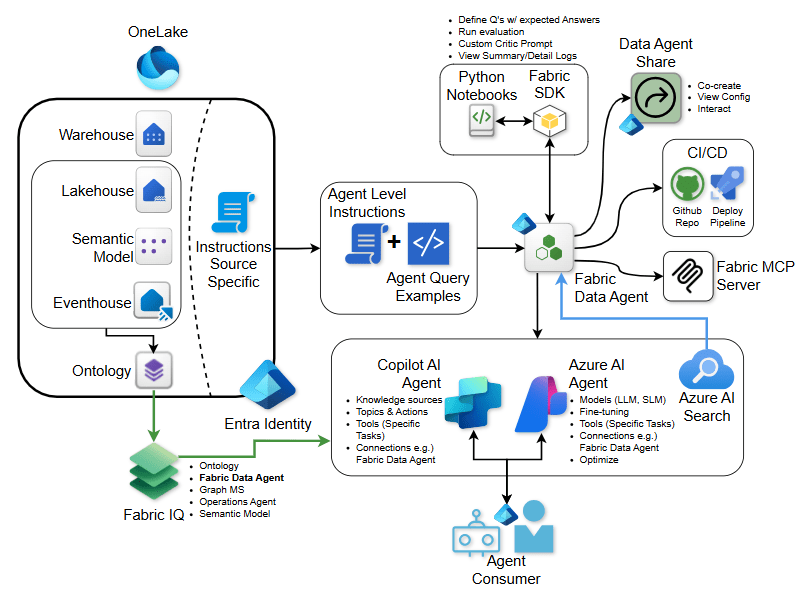
Microsoft Fabric Data Agent is an AI-powered conversational system that enables users to interact with enterprise data using natural language queries, eliminating the need for complex SQL, DAX, or KQL expertise Microsoft Learn. The system uses Azure OpenAI Assistant APIs to process questions, identify relevant data sources, and generate validated queries across lakehouses, warehouses, Power BI semantic models, KQL databases, and ontologies Microsoft Learn.
Core Capabilities
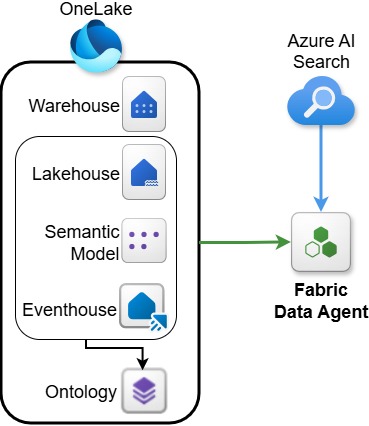
The Data Agent enforces read-only access to all data sources while respecting Row-Level Security (RLS) and Column-Level Security (CLS) policies Microsoft Learn. Recent updates expanded support to include mirrored databases, SQL databases, and unstructured data through Azure AI Search custom indexes Microsoft Fabric.
Integration with Microsoft Copilot
Data Agents integrate directly with Microsoft Copilot Studio, enabling custom AI agents to leverage enterprise data through agent-to-agent collaboration Microsoft Learn. This integration enables seamless deployment to Microsoft Teams, allowing business users to receive data-driven answers without leaving their chat environment Microsoft Fabric.
The integration process requires:
- Publishing the Data Agent in Microsoft Fabric with a detailed description Microsoft Learn
- Both services must be on the same tenant with matching account access Microsoft Learn
- Users need at least read access to both the Data Agent and underlying data sources Microsoft Learn
Integration with Azure Foundry (Microsoft Foundry)
Data Agents connect to Microsoft Foundry Agent Service using workspace and artifact IDs from published endpoints, enabling agents to query enterprise data with Identity Passthrough authorization Microsoft Learn. Foundry IQ provides enhanced context by centralizing RAG workflows into a single grounding API that respects user permissions and data classifications Microsoft Azure.
Foundry IQ automatically enforces Purview-based security on each agent call, ensuring context remains accurate, compliant, and up-to-date Microsoft Community Hub. Agents built in Microsoft Foundry can access Fabric Data Agents through hosted MCP server endpoints, enabling AI systems in VS Code and other environments to securely connect to enterprise knowledge Microsoft Fabric.
Fabric IQ: The Semantic Intelligence Layer
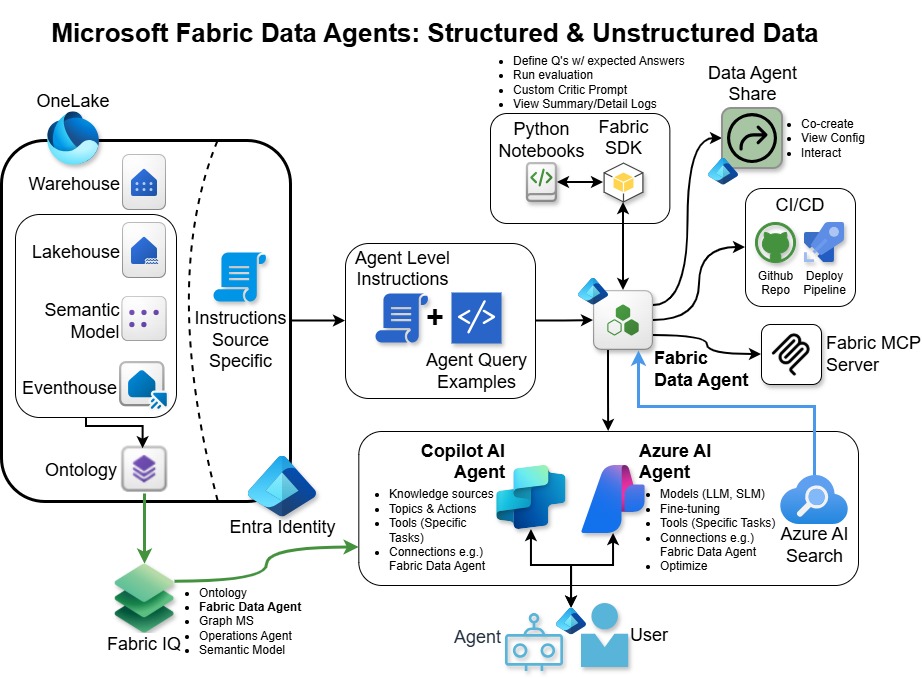
Fabric IQ introduces a semantic foundation centered on Ontology, which connects data, meaning, and actions into a unified layer that enables AI agents to reason with business language, rules, and relationships rather than raw tables Microsoft Fabric. The Ontology item organizes data across OneLake according to business concepts, providing consistent semantic meaning for analytics, AI agents, and applications Microsoft Learn.
Data Agents use Ontology definitions to understand business entities and their relationships, delivering answers that stay within business guardrails and align with organizational operations Microsoft Fabric. Organizations can jumpstart ontology creation using existing Power BI semantic models, with business experts able to build and evolve models using no-code visual tools Microsoft Fabric.
Key Benefits
- Democratized Access: Non-technical users can ask questions in plain language and receive context-rich answers without understanding data structures or query languages Microsoft Learn
- Multi-Agent Orchestration: Connected agents can delegate tasks and collaborate across systems to achieve complex business goals Microsoft Fabric
- Enterprise Security: Microsoft-managed Azure OpenAI handles authentication automatically, with data access running under user identity and workspace permissions Microsoft Learn
- Real-Time Intelligence: Operational Agents in Fabric continuously monitor business conditions, evaluate trade-offs, and automatically take actions to advance desired outcomes Microsoft Fabric
This integrated ecosystem positions Microsoft Fabric Data Agent as a central component in Microsoft’s unified intelligence platform, bridging data platforms with conversational AI capabilities while maintaining enterprise-grade governance and security.

 Ross McNeely
Leave a reply to New AI Instruction Strategy in Microsoft Fabric: A Technical Overview – Ross McNeely Cancel reply