From Raw Data to Strategic Asset: The Four Data Capability Categories
Updated Date:
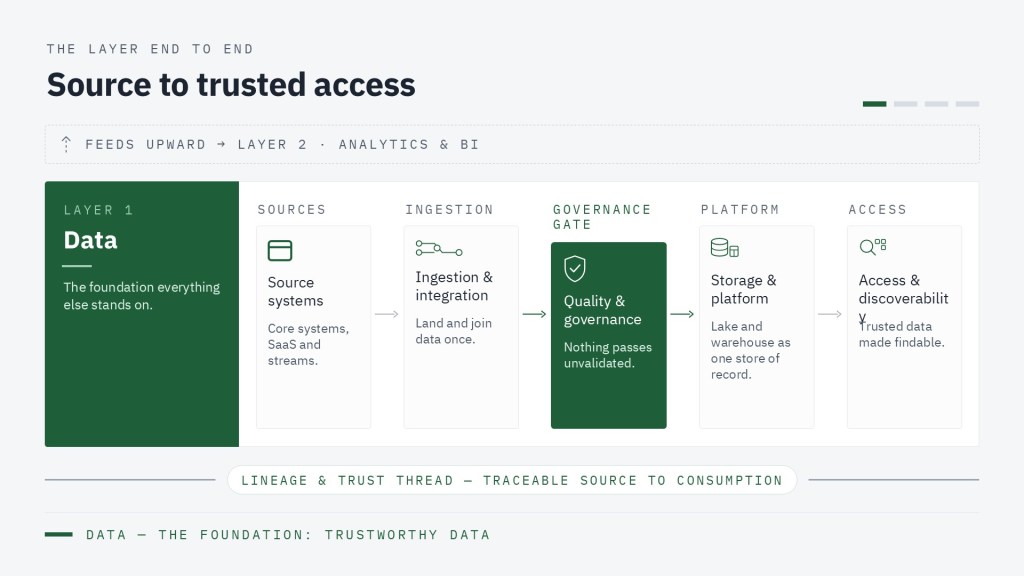
Quick answer: Enterprise data engineering capability builds out in four progressive categories: (1) Ingestion & Integration: getting data of any shape, speed, or source into the platform reliably; (2) Quality, Modeling & Governance: making that data trustworthy, well-structured, secure, and compliant; (3) Access & Discoverability: making governed data easy to find, query, and consume; and (4) Strategic Data & Document Assets: turning discoverable data into durable, versioned products the business builds on. Each layer depends on the one before it: ungoverned data that’s easy to access is a liability, not a capability, and even well-governed data nobody can find never becomes a strategic asset.
If your organization’s data conversation is stuck at “we need more pipelines,” you’re one layer into a four-layer capability. Skipping ahead by building a business-critical data product on top of ungoverned, undiscoverable tables is the single most common reason data initiatives get quietly distrusted and eventually rebuilt.
The Layered Logic: Why Order Matters
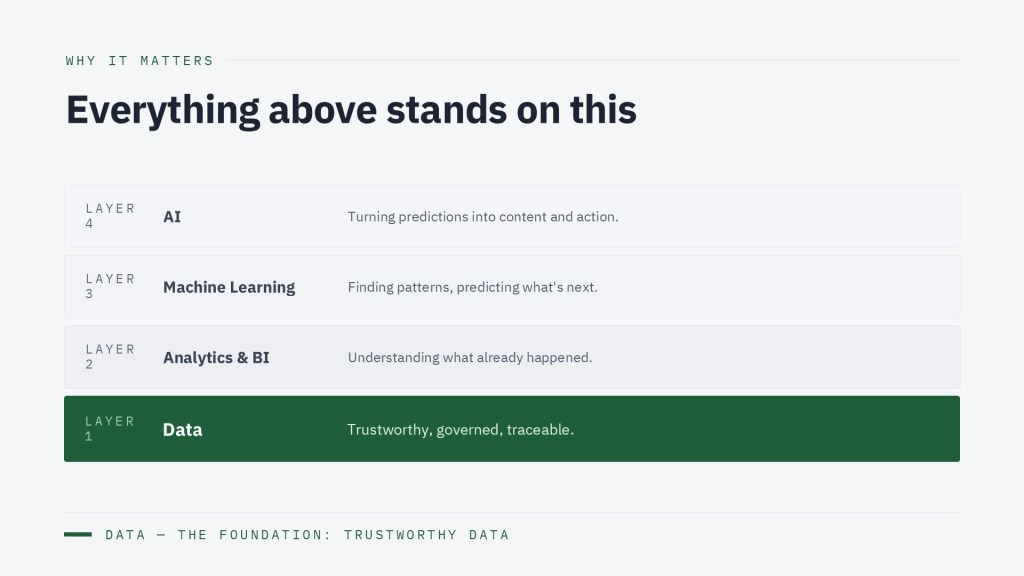
A data platform is built in layers, not all at once. Ingestion has to exist before there’s anything to govern. Governance has to exist before data can be trusted enough to expose broadly. And only once data is trustworthy and discoverable does it become a genuine strategic asset the business can build on. In practice, mature organizations build and harden all four layers in parallel and iterate continuously, but the dependency logic between them never goes away.
| Category | Core Question | Primary Focus | Maturity Signal |
|---|---|---|---|
| Ingestion & Integration | Can I get the data in, reliably, from any source? | Connectivity, transformation, orchestration | Pipelines are resilient, replayable, and rarely paged on |
| Quality, Modeling & Governance | Can I trust this data and control who touches it? | Quality checks, schema design, lineage, security | Data passes quality gates automatically, access is least-privilege by default |
| Access & Discoverability | Can the right people actually find and use it? | Cataloging, query layers, self-service prep | Business users self-serve without engineering intervention |
| Strategic Data & Document Assets | Does this data outlive the pipeline that created it? | Data products, lifecycle management, documentation | Other teams depend on it with a defined, versioned contract |
1. Ingestion & Integration: Getting Data In, Reliably
What it is: The foundational layer that gets data of any shape, speed, and source into the platform and shapes it into a usable form.
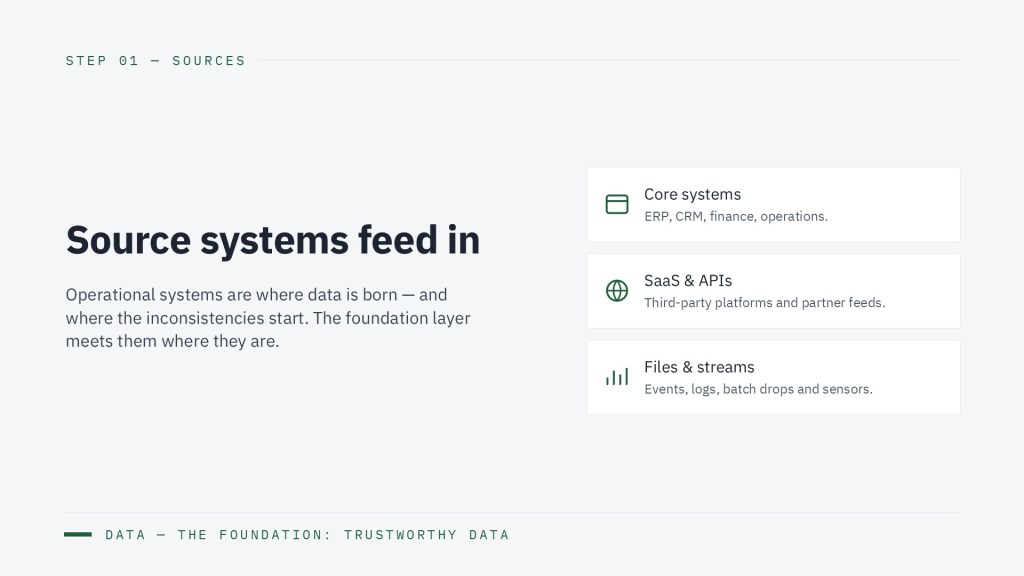
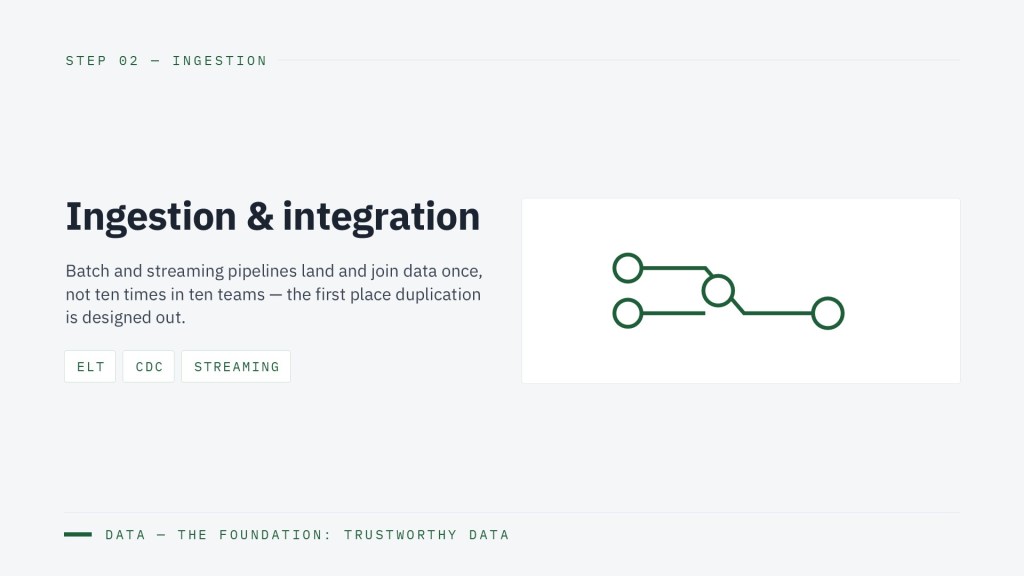
This category starts with source connectivity: streaming sources, batch sources, direct database connections, and APIs treated as first-class ingestion sources rather than an afterthought bolted onto files and tables. From there, the real engineering work is in the ingestion patterns with tuning batch configuration, managing throttling against sensitive operational systems, handling fan-in/fan-out for streaming distribution, and designing pipelines that can replay a window of data without side effects. Getting replay and idempotency right early is what separates a pipeline that’s merely working from one that’s actually reliable under failure.
Transformation follows: choosing the right processing engine for the workload, converting formats for cost and performance, integrating multiple sources into a unified model, and increasingly, folding LLMs into transformation logic itself for entity extraction and enrichment. Underneath all of it sits orchestration and engineering discipline for workflow orchestration, event driven triggers, failure notification, version control, and Infrastructure as Code that is built for performance and fault tolerance from day one, not retrofitted after the first outage.
Why it matters: If ingestion isn’t reliable and replayable, every downstream layer inherits that instability. A quality check built on top of a flaky pipeline is just monitoring the flakiness, not fixing it.
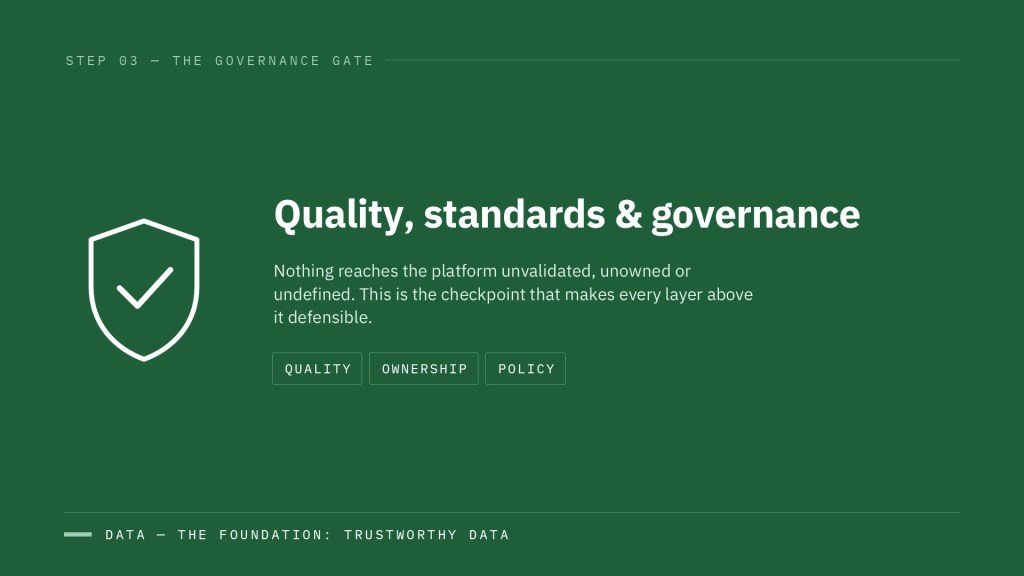
2. Quality, Modeling & Governance: Making Data Trustworthy
What it is: The layer that makes ingested data trustworthy, well-structured, secure, and compliant before anyone relies on it.
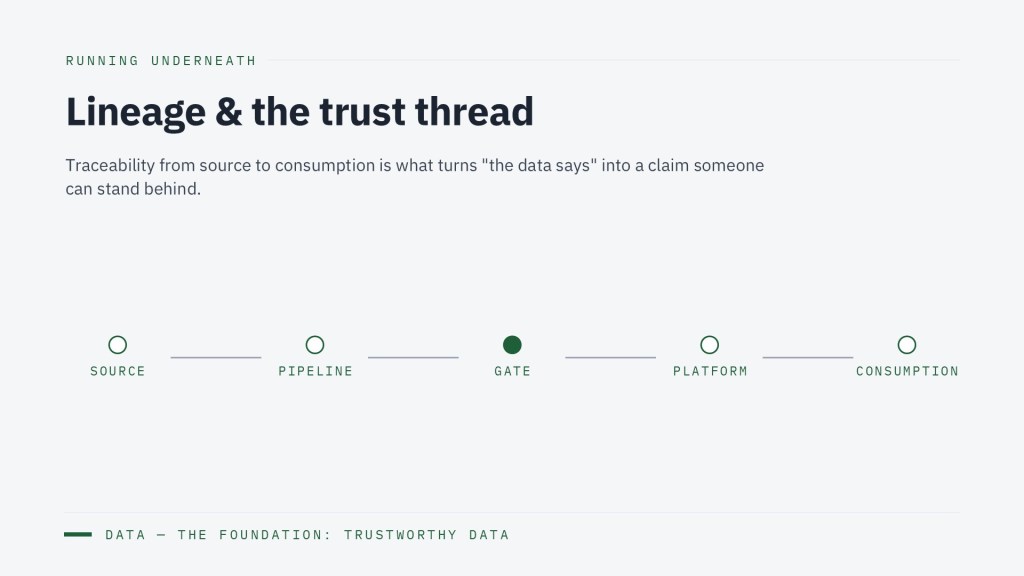
This is where four related disciplines converge. Data quality means running checks inline with processing for null checks, type validation, referential checks rather than discovering problems after a report ships. Data modeling means designing schemas fit for the target store and planning explicitly for schema evolution, so new columns or type changes don’t silently break downstream consumers; it increasingly extends into newer territory like vectorization and vector indexing for embeddings. Data lineage turns tracked movement and transformation into an operational safety net for impact analysis and audit response, not just documentation nobody reads. And security for authentication, authorization, encryption, masking, and PII identification which has to be mapped to actual compliance requirements, not generic best practice, with governance and audit trails established before data sharing happens, not after.
Why it matters: Ungoverned data that’s easy to access isn’t a capability, but a liability waiting for an audit. This layer is what lets “the data says X” carry any actual authority.
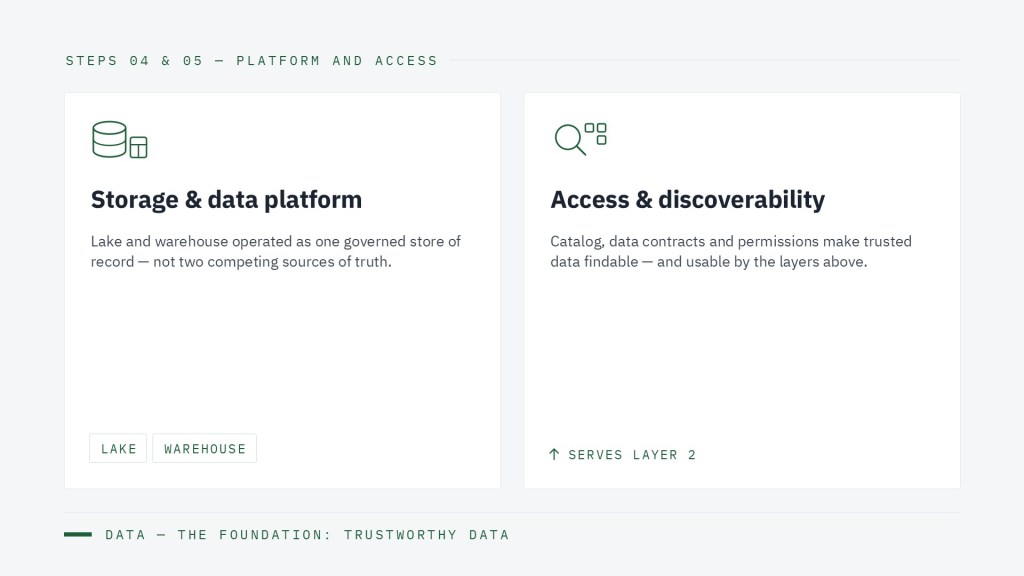
3. Access & Discoverability: Making Governed Data Usable
What it is: The layer that makes governed data easy to find, query, and consume by the people and systems that actually need it.
Cataloging comes first: a technical catalog as the single source of truth for schema metadata, kept current by crawlers rather than manual updates, layered with a business catalog so non-engineers can find data in business terms instead of table and column names. On top of that sits the query and analysis layer of SQL-based self-service querying, federated queries and materialized views to avoid unnecessary data movement, and exploratory analysis tooling for deeper prep work. Visualization and self-service data prep let business analysts clean and shape data themselves, and controlled sharing mechanisms make cross-team and cross-domain access deliberate, discoverable, and auditable rather than achieved through ad hoc copies that nobody can trace later.
Why it matters: Even perfectly governed data that nobody can find never gets used instead it just becomes governed shelf-ware. This layer is the difference between data existing and data being usable.
4. Strategic Data & Document Assets: Building Durable Value
What it is: The most mature layer turning well-governed, discoverable data into durable, reusable assets the organization actually builds strategy on, including the documentation and lineage records that keep those assets trustworthy over time.
This starts with promoting pipeline output into stable, versioned data products for datasets and APIs that internal or external consumers can depend on under a defined contract, instead of raw tables that reshape without warning. Lifecycle management treats retention as a deliberate discipline: storage tiering, versioning, TTLs, and open table formats that support time travel and concurrent writers as datasets mature into long-lived assets. Cost and performance become ongoing stewardship rather than a one-time optimization pass, tuned continuously against actual access patterns. And documentation on lineage records, business catalog entries, and data dictionaries becomes a first-class deliverable maintained by the pipeline itself, not written once at launch and left to rot. At the most advanced end, this layer includes vectorized and embedded representations of enterprise content: knowledge bases that turn unstructured documents into queryable, reusable assets for LLM-powered applications.
Why it matters: This is the layer where data engineering stops being a cost center that keeps pipelines running and starts being the thing the business’s next three initiatives are built on top of.
Each layer depends on the one before it being solid. Skip governance and your access layer just makes untrustworthy data easier to find faster. Skip discoverability and your best-governed dataset sits unused because nobody outside the team that built it knows it exists. The loop back from Strategic Assets to Ingestion is not decorative, but new requirements surfaced by how a data product actually gets used routinely reshape what gets ingested and how, next.
Who Owns the Foundation? The Case for a Single Data, Analytics, and AI Leader
The layered logic above has an organizational corollary: if each capability layer depends on the one beneath it, someone has to own the whole stack, not just the top of it. In a December 2025 Harvard Business Review article, Vipin Gopal, Thomas H. Davenport, and Randy Bean argue that most enterprises should consolidate data, analytics, and AI under a single Chief Data, Analytics, and AI Officer (CDAIO), with the traditional data charter of governance, platform, quality, architecture, and privacy folded into that leader’s remit as one component. Their reasoning maps directly to these four categories. Early Chief Data Officers struggled to prove ROI because a mission built solely on ingestion, governance, and cataloging rarely shows up on a P&L by itself. AI changes that equation: it gives foundational data investment a visible channel for value, and 93% of the leaders the authors surveyed say AI is increasing their focus on data. The authors also flag that generative AI runs primarily on unstructured data, whose quality approaches differ sharply from those for structured tables. That is exactly why Strategic Data & Document Assets, including vectorized knowledge bases, belong in the data platform rather than being bolted on by an AI team later. When one leader owns both the foundation and the AI initiatives built on it, the foundation stops being a cost center that has to justify itself and becomes the reason the AI actually works.
Frequently Asked Questions
What are the four data engineering capability categories? Ingestion & Integration (getting data in), Quality, Modeling & Governance (making it trustworthy), Access & Discoverability (making it findable and usable), and Strategic Data & Document Assets (making it a durable, reusable asset). They form a dependency chain, not four independent workstreams.
Which category should an organization invest in first? Ingestion & Integration, always needed, without it there is nothing to govern, catalog, or productize without reliable data flowing in. But mature organizations don’t fully “finish” one layer before starting the next; they build all four in parallel and harden them continuously.
What’s the difference between data governance and data discoverability? Governance determines whether data can be trusted and who’s allowed to touch it. Add in pipeline quality checks, lineage, security, and compliance for quality. Discoverability determines whether the people who are allowed to use it can actually find it and query it without engineering help. You need both; one without the other produces either untrustworthy self-service or perfectly governed data nobody uses.
What makes a dataset a “strategic asset” rather than just a governed table? A strategic data asset is promoted into a stable, versioned data product with a defined contract that other teams or systems can depend on plus the lifecycle management, cost stewardship, and living documentation that keep it trustworthy as it ages. A governed table becomes a strategic asset when someone outside the team that built it is allowed to depend on it without asking permission every time.
Do you have to complete each layer before starting the next? Functionally, yes, for a first build and then each layer inherits the reliability (or dysfunction) of the one below it. Data exposed broadly before it’s governed, or productized before it’s discoverable, tends to surface as a trust problem later rather than saving time now.