The 4 ML Capability Categories Every Enterprise Architecture Needs
Updated Date:
Most organizations talk about “machine learning” as if it’s one thing. It isn’t. A churn-prediction model, a retrieval augmented chatbot, an agent that automatically reprocesses failed invoices, and a real-time credit approval engine are all “ML”, but they are built differently, monitored differently, and fail in completely different ways.
Treating them as a single category is where enterprise ML architecture goes wrong. Teams apply generative AI evaluation techniques to a fraud model, or skip explainability requirements on a system that is quietly making loan decisions, simply because nobody drew the boundary between capability types.
This guide breaks enterprise machine learning into four distinct capability categories, each following the same four-phase lifecycle of Data Preparation, Development, Deployment & Orchestration, and Operations/Monitoring/Security, but applying that lifecycle with very different emphasis, tooling, and risk posture.
The Common Lifecycle Behind Every ML Capability
Before splitting into categories, it helps to see what they share. Every ML capability, regardless of type, moves through the same four phases:
| Phase | Purpose |
|---|---|
| 1. Data Preparation | Collect, store, transform, and validate the data the capability depends on |
| 2. Development | Select an approach, train or tune it, and evaluate results |
| 3. Deployment & Orchestration | Provision infrastructure, host the model, and automate the pipeline around it |
| 4. Operations, Monitoring & Security | Detect drift, control cost, and secure access on an ongoing basis |
The four categories below are the same lifecycle, tuned four different ways.
1. Predictive ML Models
What it is: Traditional supervised and unsupervised models that forecast a numeric or categorical outcome from structured or semi-structured data where you can think churn prediction, demand forecasting, fraud scoring, or anomaly detection.
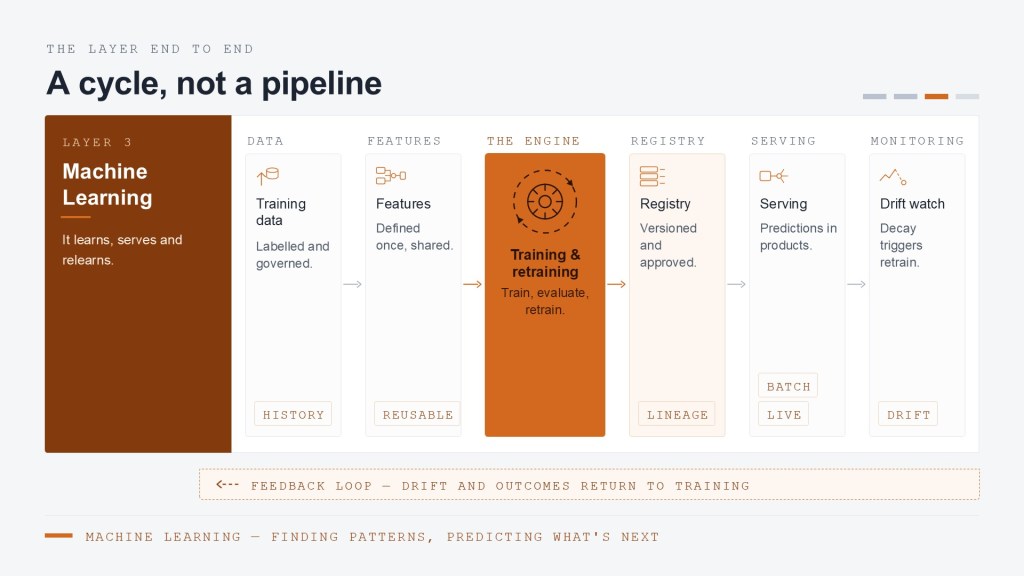
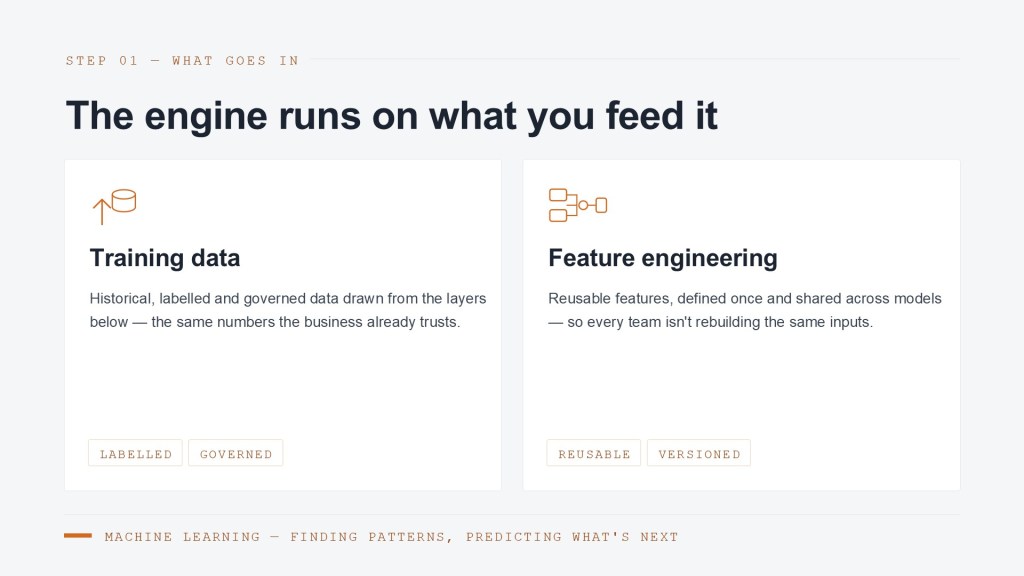
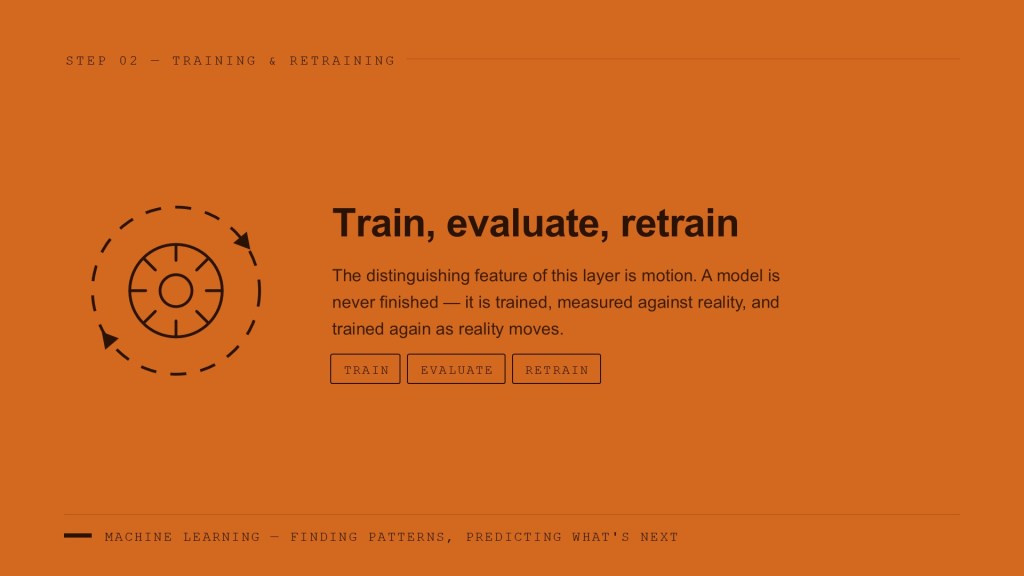
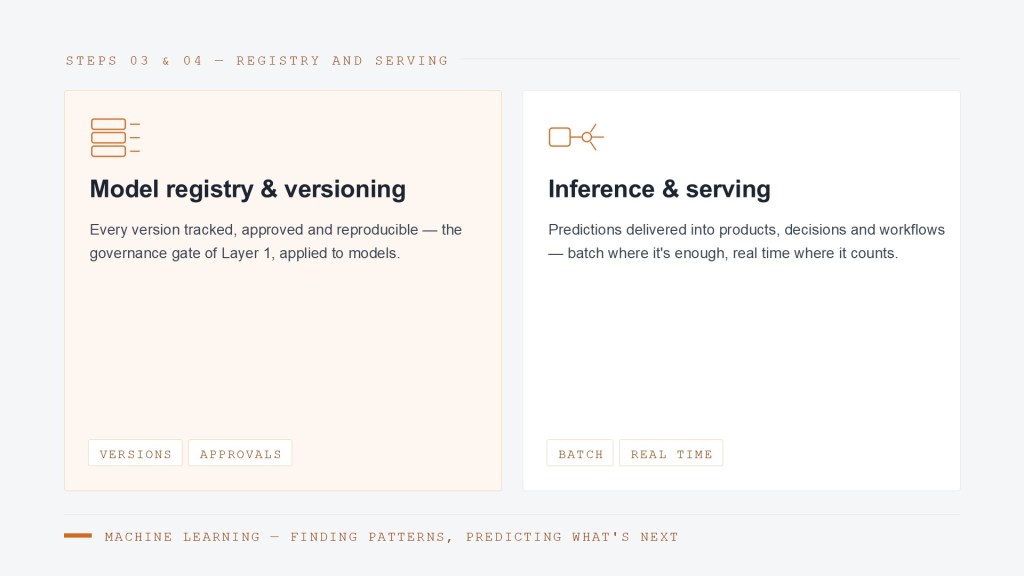
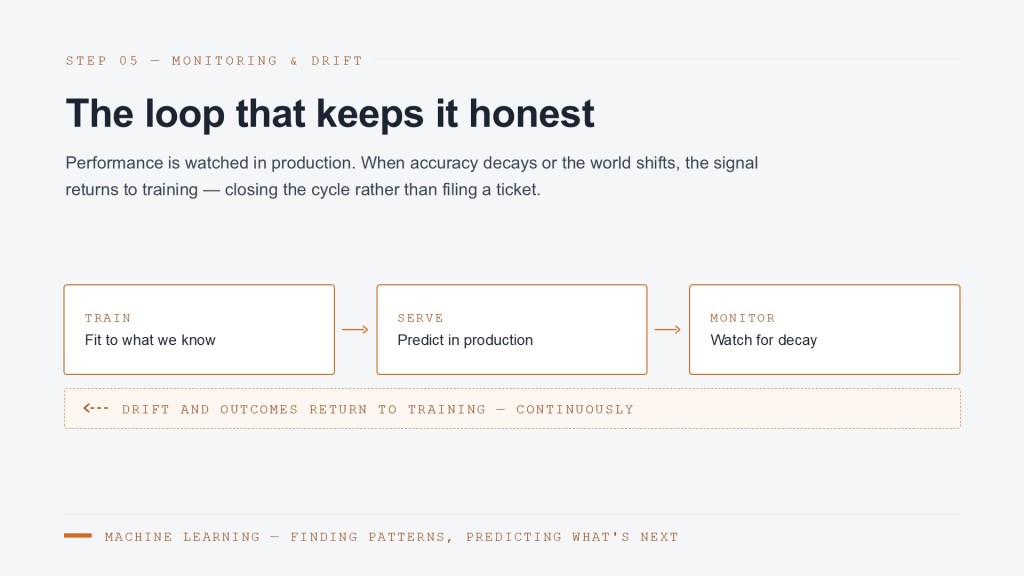
This is the category most people picture when they hear “machine learning,” and it’s the most mature in terms of tooling and process. The architecture runs from feature engineering and data quality checks, through model selection (built-in algorithms, custom scripts, or AutoML) and hyperparameter tuning, to real-time or batch deployment behind an auto-scaled, least-privilege endpoint. Everything is versioned in a model registry so any prediction can be traced back to the exact model that produced it, and retraining is triggered automatically on a schedule or when drift is detected.
Design priorities: accuracy versus cost/latency tradeoffs, reproducibility, drift detection, and auditability of model versions.
2. Advanced ML Systems
What it is: Foundation-model and generative AI systems with retrieval augmented generation (RAG), fine-tuned or customized large language models, multimodal systems, and agentic architectures built on top of them.
This category introduces problems predictive ML never had to solve: chunking documents for retrieval, choosing an embedding strategy, deciding between prompt engineering, fine-tuning, or RAG (or some hybrid), and evaluating output quality with metrics like BLEU, ROUGE, and LLM-as-a-judge rather than a simple accuracy score. Deployment means choosing between on-demand and provisioned foundation model hosting, and operations means watching for a very different kind of drift, such as, degradation in generated output, not just a shifting input distribution while layering in guardrails for safety and sensitive data protection.
Design priorities: grounding and factual accuracy of generated output, retrieval quality, responsible AI safeguards, cost per token or embedding, and generation latency.
3. Process Automation
What it is: ML and AI enabled automation of operational workflows with both document and data processing pipelines, agentic task execution, and the automated retraining or deployment pipelines that reduce manual engineering effort.
Here, the architecture is less about a single model and more about orchestration: decomposing a business process into discrete ML/AI steps and deterministic logic steps, then sequencing them with tools like (AWS) Step Functions or agent frameworks, complete with branching and error paths. Agents need persistent state to track context across multi-step or long-running interactions, and the CI/CD pipeline has to support automated testing of agent behavior, not just code. Monitoring has to catch automation specific failure modes with coordination failures between agents, truncated streaming, failed tool calls, and runaway resource consumption that do not show up in a traditional ML monitoring dashboard.
Design priorities: reliability of unattended execution, graceful failure and rollback handling, end-to-end auditability, and cost control on autonomous or agentic loops.
4. ML-Driven Decisioning
What it is: Systems where ML or AI output directly drives or supports a business decision in production with real-time approval scoring, recommendation ranking, dynamic pricing, risk decisioning, or human-in-the-loop review workflows.
This is the highest stakes category, and the architecture reflects that. Bias mitigation and class-imbalance correction happen before training even starts. Model choice weighs explainability as heavily as accuracy, because a decision that can’t be explained often can’t be deployed in a regulated context. Every decision path needs feature attribution and confidence scoring so it can be audited or appealed, and models are shadow deployed against live traffic before they’re allowed to cut over. Critically, decision models and their associated business rules are versioned together, so any single decision can be traced back to the exact model plus rules combination that produced it, and retraining is triggered by decision quality metrics like approval rate drift, not just statistical drift in the data.
Design priorities: explainability, fairness and bias monitoring, traceability of every decision to a model version, human-in-the-loop escalation paths, and regulatory auditability.
Why the Distinction Matters
The point of separating these four categories isn’t academic. It changes what “done” looks like for a given project, what questions a review board should ask, and what breaks first when something goes wrong:
- A predictive model that drifts silently produces bad forecasts.
- An advanced ML system that drifts silently produces confident-sounding, wrong answers.
- Process automation that fails silently produces a stalled or duplicated business process.
- ML-driven decisioning that fails silently produces an unexplainable, potentially non-compliant decision about a real person.
Each of those failure modes needs a different monitoring strategy, a different escalation path, and a different sign-off before launch. An enterprise ML architecture that applies one evaluation framework across all four is either over-engineering the low-risk categories or under governing the high-risk ones.
Who Decides Which Models Earn Their Place?
Distinguishing between the four ML categories also clarifies what kind of leadership an ML portfolio needs. In their December 2025 Harvard Business Review article, Gopal, Davenport, and Bean describe the ideal Chief Data, Analytics, and AI Officer as both an evangelist and a realist. That leader champions ML adoption but also has the discipline to terminate initiatives that aren’t delivering a return. For ML, that realism has to be category-aware. A churn model and a credit-decisioning engine should face very different ROI hurdles and sign-off paths, because their failure costs are completely different. The authors also call for unified governance of AI-specific risks such as safety, privacy, IP, and regulatory exposure, built in partnership with legal and compliance. That is precisely the review burden that ML-Driven Decisioning carries and that Predictive ML usually doesn’t. Finally, they argue that tool fragmentation adds cost and lowers the odds of successful use cases, recommending that the CDAIO provide secure “AI platforms as products” that teams can adopt with minimal friction. In ML terms, that means one shared feature store, model registry, and monitoring stack across all four categories, rather than each team standing up its own. A single owner across data, analytics, and ML means fewer hand-offs between the people who prepare the data and the people who train on it. In ML, those hand-offs are where lineage and reproducibility get lost.
Cross-Cutting Considerations
A few things apply uniformly no matter which category a capability falls into:
- Cost management: right-size compute, monitor token/embedding/vector-storage spend for generative workloads, and set cost quotas, especially for agentic loops that can run away.
- Security by default: least-privilege access, network isolation, encryption at rest and in transit, and vulnerability scanning in the CI/CD pipeline.
- Versioning and reproducibility: models, prompts, features, and infrastructure should be versioned together so any production behavior can be reproduced or rolled back.
- Observability: combine infrastructure-level monitoring with ML/AI-specific observability with drift detection, generation-quality evaluation, agent-failure detection, since healthy infrastructure doesn’t guarantee a healthy model or decision.
Quick Summary
“We’re building an ML capability” is not a complete architecture brief. Knowing whether that capability is a predictive model, an advanced/generative system, a process automation, or a decisioning engine determines the data pipeline you need, the evaluation metrics that matter, the deployment pattern that fits, and most importantly the governance and monitoring required to run it safely in production. Get the category right first, and the rest of the architecture follows.