The 4 Stages of Generative AI Maturity: From NLP Basics to Autonomous Multi-Agent Systems
Updated Date:
Quick answer: Enterprise generative AI capability builds out in four progressive categories: (1) NLP & Computer Vision Basics: foundation models and clean data pipelines; (2) GenAI Applications: retrieval augmented generation, prompt management, and product integration; (3) Multi-Agent Systems: agents that reason, use tools, and collaborate; and (4) AI Orchestration and Autonomous Systems: the enterprise integration, safety, cost, and observability layer that lets all of the above run at scale with minimal supervision. Each stage builds on the one before it, and skipping a stage tends to surface as a production failure later rather than saving time now.
Most organizations don’t fail at generative AI because the model is bad. They fail because they try to build stage 3 capability (multi-agent systems) on top of stage 1 infrastructure (no data validation, no model lifecycle management) and wonder why nothing is reliable. Understanding the four stages and what each one actually requires and what it unlocks is the fastest way to diagnose where your GenAI initiative really stands.
Stage 1) NLP & Computer Vision Basics: The Foundation Everything Else Depends On
This is the stage that gets skipped most often, because it’s the least exciting to demo. It covers four things:
- Selecting foundation models. Understanding the landscape of text, vision, and multimodal models (for example, those available through Amazon Bedrock), and evaluating them on benchmarks, cost, latency, and task fit. Not just picking the biggest model available.
- Data validation and processing pipelines. Every modality: text, image, audio, and tabular needs its own cleanup and quality checks before it ever reaches a model. Garbage in, hallucinated garbage out.
- Customizing and deploying base models. Deciding between using a model as-is, prompt-only customization, or deeper fine-tuning, and then managing that model through a registry with versioning and rollback, because models get replaced, and you need to know what’s running where.
- Foundational infrastructure patterns. Making model selection a configuration choice, not a hardcoded one, and designing for resilience (cross-region inference, circuit breakers) from day one.
Why it matters: If you can’t reliably get clean, well-formatted data into a chosen model and swap that model later without re-architecting everything then nothing built on top of this layer will be stable.
Stage 2) GenAI Applications: Where RAG, Prompting, and Real Products Live
This is the stage most people mean when they say “we’re building a GenAI application.” It has four components:
- Solution design and validation. Translating a business requirement into an architecture: which models, which integration pattern (sync, streaming, batch), which deployment approach, and proving it out with a proof of concept before committing to full build out.
- Vector store and retrieval infrastructure (RAG). This is where most of the real engineering effort goes: vector database architecture, metadata tagging, document chunking strategy, embedding model selection, hybrid search and reranking, query reformulation, and pipelines that keep the vector store from going stale.
- Prompt engineering and management. Treating prompts as governed artifacts: version-controlled, parameterized, and audited rather than strings hardcoded into application code. This includes guardrails, conversational memory, and chaining prompts for multi-step tasks.
- Integration into applications. Exposing the model through the right interface (streaming for chat, batch for reporting), adding resilience patterns (backoff, fallback models, rate limiting), and routing requests intelligently by cost or complexity.
Why it matters: This is the stage where a model actually becomes grounded in your organization’s own data and usable inside a real interface which is the difference between a demo and a product.
Stage 3) Multi-Agent Systems: When Models Start Reasoning and Collaborating
Once single-model applications are solid, the next stage is agentic: models that don’t just respond, but plan, act, and coordinate.
- Individual agents. Agents need memory and state across a task, structured reasoning patterns (like ReAct or chain-of-thought) to break down complex problems, and reliable tool integration often via MCP (Model Context Protocol) servers.
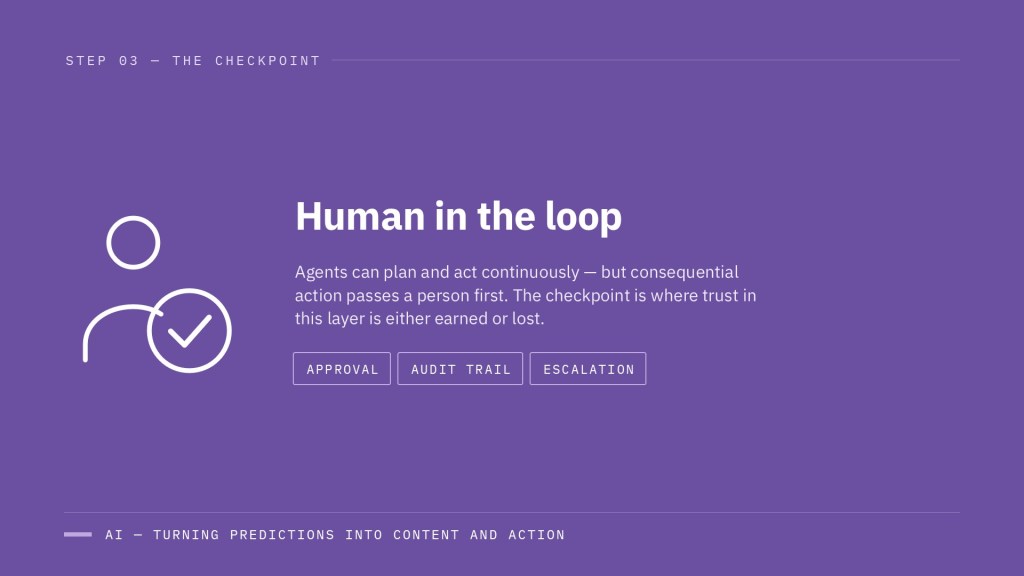
- Multi-agent coordination. Specialized agents route sub-tasks to each other and aggregate results, with human-in-the-loop checkpoints for anything high-stakes.
- Constraining agent behavior. Stopping conditions, timeouts, least-privilege IAM policies, and circuit breakers so an agent can’t loop indefinitely, rack up cost, or take action outside its lane.
- Evaluating agent performance. Measuring task completion and tool-usage effectiveness, and not just whether the final output looks right, but whether the reasoning path that produced it was sound.
Why it matters: This is where GenAI stops being “answer a question” and starts being “get something done” which is also where the risk profile changes and guardrails stop being optional.
Stage 4) AI Orchestration, Autonomous Systems & Governance: Running It Safely at Scale
The final stage isn’t a new capability so much as the connective tissue that makes stages 1–3 trustworthy in production:
- Enterprise integration and deployment: connecting GenAI to legacy systems via loosely coupled, event-driven architectures, with CI/CD pipelines built for GenAI-specific testing and rollback.
- Safety, security, and responsible AI: input/output filtering, hallucination reduction through grounding and structured outputs, prompt-injection defense, PII handling, and maintained model cards and audit logs.
- Cost optimization: matching model size to task complexity, caching, and tuning throughput so autonomy doesn’t mean unbounded spend.
- Monitoring and observability: GenAI-specific KPIs like hallucination rate and token usage, plus tracing across agent-to-agent handoffs and vector store health.
- Testing and validation at scale: continuous automated evaluation, RAG quality checks separate from generation quality, and quality gates that block bad deployments.
Why it matters: This is the layer that lets an organization say yes to autonomy with confidence with safe, observable, cost-efficient, and continuously validated, rather than autonomous and unaccountable.
The Four Stages at a Glance
| Stage | Category | Core Question It Answers |
|---|---|---|
| 1 | NLP & Computer Vision Basics | Can I get clean, well-understood data into the right model? |
| 2 | GenAI Applications | Can I ground that model in my own data and integrate it into a real product? |
| 3 | Multi-Agent Systems | Can multiple models or agents collaborate to solve harder problems? |
| 4 | AI Orchestration & Autonomous Systems | Can this run safely, affordably, and observably at scale and with minimal supervision? |
It’s a Loop, Not a Ladder
These four stages are sequential the first time an organization builds a GenAI capability, but in practice they form a loop: monitoring and evaluation data from Stage 4 feeds back into model selection and pipeline improvements in Stage 1, driving the next iteration. Mature GenAI programs aren’t the ones that “finished” all four stages once they’re the ones that keep cycling through them as models, data, and business needs change.
Why the Four Stages Need One Owner
The most common GenAI failure pattern described above is building Stage 3 agents on Stage 1 infrastructure. It is usually not a technical mistake so much as an organizational one. Gopal, Davenport, and Bean observe in Harvard Business Review article (December 2025) that the surge of interest in AI led many organizations to launch pilots rapidly and often without coordination. They note that early evidence shows only a small fraction of companies reporting positive P&L impact from generative AI. Their prescription is a single Chief Data, Analytics, and AI Officer who owns the enterprise AI thesis: how AI creates value, the roadmap to get there, and the ROI hypothesis the board signs off on. That mandate lines up with all four stages. Making data AI-ready, especially the unstructured data generative AI depends on, is Stage 1. Providing a consolidated, secure platform teams can build on is Stages 2 and 3. Governing new classes of risk and measuring AI KPIs at least quarterly is Stage 4. The authors add a point that no architecture diagram captures: the long-term winners may not be the organizations with the best AI technology, but those with a culture of adoption that actually uses it. That cultural work, done in partnership with HR, is what turns autonomous systems from impressive pilots into an enterprise operating capability.
Frequently Asked Questions
What is the first stage of building generative AI capabilities? The first stage is NLP and computer vision basics: selecting the right foundation models, building data validation pipelines, and establishing infrastructure that lets you swap models without re-architecting the system.
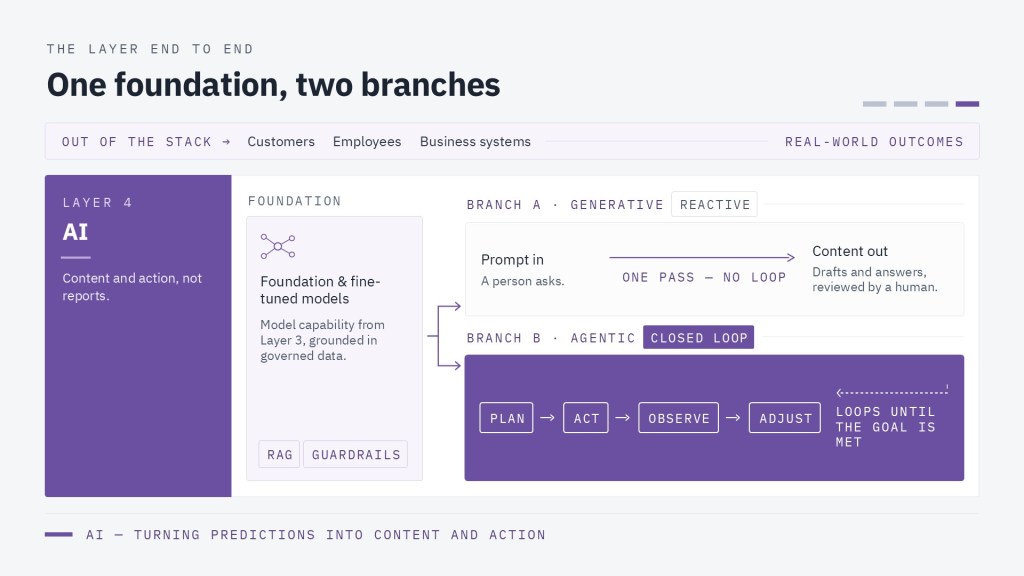
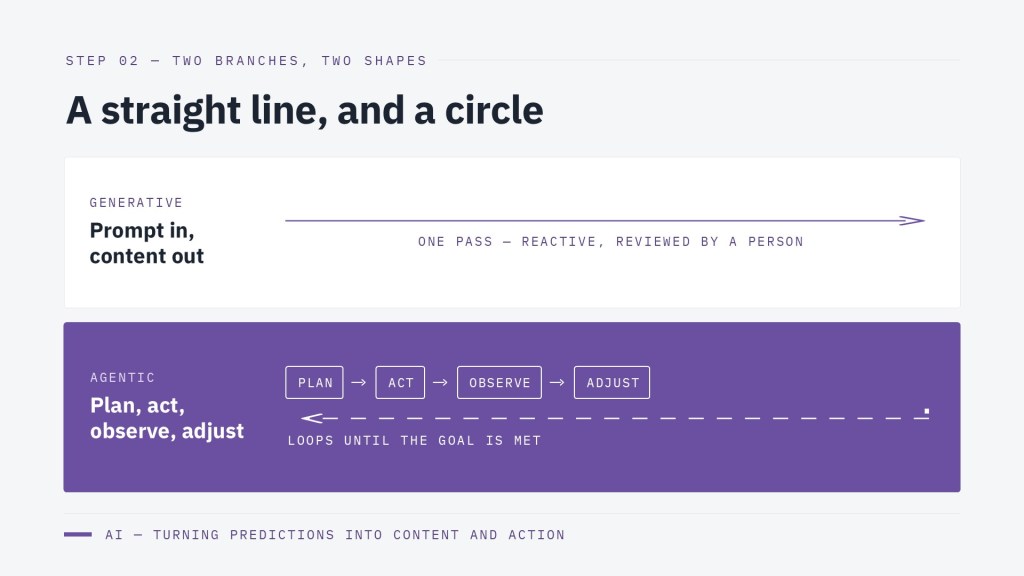
What’s the difference between GenAI applications and multi-agent systems? A GenAI application (Stage 2) responds to a prompt with generated content in a single exchange, typically grounded in your data through retrieval-augmented generation (RAG). A multi-agent system (Stage 3) pursues a goal with more autonomy, planning steps, using tools, and coordinating with other agents with limited human intervention.
Do you need to complete each stage before starting the next? Largely yes for a first build then each stage depends on the reliability of the one before it. A multi-agent system built on ungoverned data pipelines will inherit that instability. That said, the four stages become a continuous loop over time rather than a one-time sequence.
Why does orchestration and governance come last instead of first? Orchestration and governance (Stage 4) apply across all the other stages, but you can’t meaningfully monitor, secure, or cost-optimize a system that doesn’t exist yet. It comes “last” in build order, but it needs to be designed for from the start, not bolted on afterward.