
Updated Date:
Enterprise AI faces a fundamental trust problem. While language models generate fluent responses, users increasingly question whether those answers are actually true. The solution is not more sophisticated text generation. Instead, the answer is intelligent orchestration of verified data sources with quality measurement.
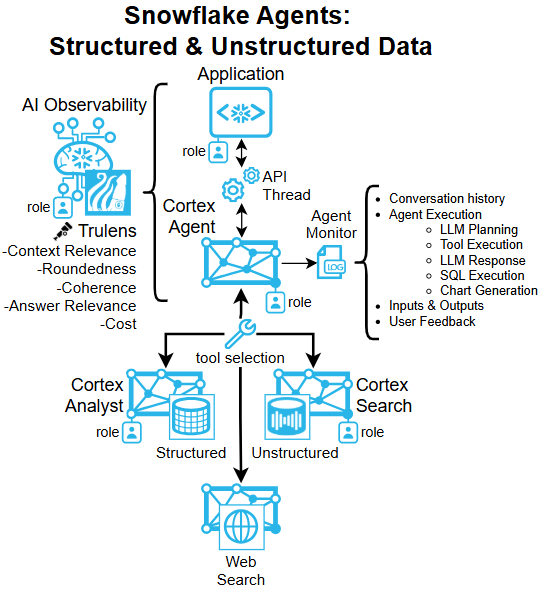
Snowflake Cortex Agents solve this through a three-tier architecture that automatically routes questions to the right data source: Cortex Analyst for structured database queries, Cortex Search for semantic document retrieval, and web search for external information. More importantly, every response is evaluated for accuracy and relevance through integrated TruLens observability.
Why Multi-Source Orchestration Matters
Traditional AI assistants rely on single data sources. A SQL bot answers “What were Q4 sales?” but fails on “What is our remote work policy?” A document chatbot handles policies but cannot calculate metrics. Web assistants provide current information but lack proprietary business data.
Real business questions demand multiple sources. When a sales leader asks “How does our Q4 performance compare to competitors?”, the complete answer requires internal metrics from your data warehouse, strategic context from internal documents, and external market intelligence from industry analysts.
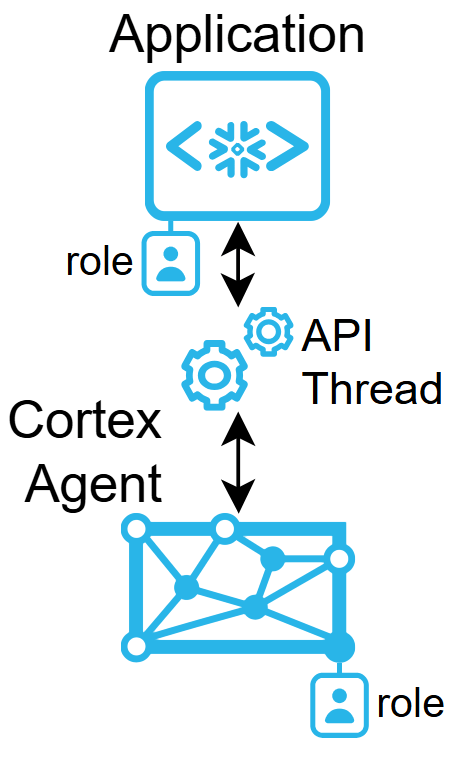
Cortex Agents handle this automatically. The system analyzes each question, determines which data sources are needed, retrieves information from appropriate tools, and synthesizes results into coherent answers and all transparently orchestrated behind a simple natural language interface.
The Core Data Architecture
Cortex Analyst semantic views give the agent precise, governed access to structured data. Questions involving metrics, trends, or calculations route here automatically, enabling business users to access data warehouse insights without technical expertise. As of April 2026, agents generate the SQL directly against these semantic views rather than delegating that step to a separate Cortex Analyst call. This is a change Snowflake made to cut latency and improve accuracy. (If you’re parsing agent traces or usage logs, note that this also changed the API: tool blocks that used to appear as cortex_analyst_text_to_sql now appear as system_execute_sql, and the associated token/credit usage now reports under cortex_agents rather than a separate cortex_analyst line.) When accuracy matters for revenue figures, customer counts, or performance metrics, this structured path provides authoritative data
Cortex Search uses vector embeddings for semantic understanding of unstructured content. Documents, reports, policies, and knowledge bases become searchable by meaning rather than keywords. Asking about “employee benefits eligibility” retrieves relevant content even when documents use different terminology like “staff compensation programs.”
Web search activates automatically when internal sources lack information. Through relevance scoring, knowledge gaps can be detected and supplemented with external data. If internal results score below a confidence threshold (typically 0.7), you can expand to web sources for industry benchmarks, current events, or competitive intelligence.

This intelligent routing ensures complete answers while preferring proprietary data when available. Snowflake has also expanded what agents can reach beyond these three: a sandboxed code execution tool for Python, MCP connectors for external SaaS tools, and custom tools backed by user-defined functions or stored procedures. The core pattern now routes to the right source, then synthesize and stays the same as the toolset grows
Ensuring Quality Through TruLens Observability
Building AI agents is half the challenge. The other half is maintaining quality through observability measurement. TruLens integration provides automated evaluation across four critical dimensions:
Context Relevance (target ≥0.8) measures whether retrieved information actually relates to the question, preventing irrelevant content from confusing responses.
Groundedness (target ≥0.85) evaluates whether responses are factually supported by evidence, defending against hallucination where models generate plausible but incorrect information.
Answer Relevance (target ≥0.8) measures how directly responses address what users asked, ensuring complete and focused answers.
Using the AI Session Thread and tagging you can do Cost Tracking to provide granular visibility into compute credits, API calls, and resource consumption per query, enabling budget management and optimization for AI in Snowflake.
TruLens isn’t the only evaluation option in the stack anymore. Snowflake’s own Cortex Agent evaluations went GA in March 2026, letting you monitor agent behavior directly against ground-truth metrics like answer correctness (how closely a response matches a prepared expected answer) and reference-free metrics like logical consistency (whether the agent’s instructions, planning, and tool calls hold together), plus custom metrics you define. The two aren’t competing so much as covering different angles: TruLens is strong on context relevance, groundedness, and answer relevance scored against retrieved evidence, while native evaluations are better suited to correctness against a fixed test set and to catching agents that plan or reason inconsistently even when individual tool calls succeed. Many teams will want both.
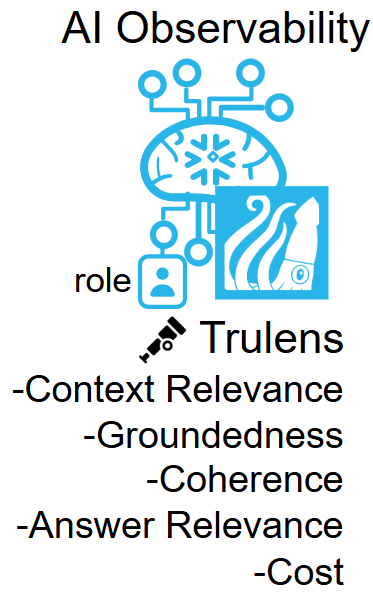
These metrics create accountability. Teams have quantitative measures of accuracy that can be tracked over time, alerted on when they degrade, and systematically improved through experimentation.
Real-World Example: Sales Analysis
A sales executive asks: “How did our enterprise segment perform compared to industry growth?”
The agent queries the data warehouse via Cortex Analyst, returning 18% internal growth for Q4. Relevance scoring detects missing benchmark data and triggers web search, retrieving analyst reports showing 12% industry growth.
The synthesized response: “Your enterprise segment grew 18% in Q4, outpacing the industry average of 12% according to recent market analysis.”
TruLens validates high groundedness (facts traced to sources), context relevance (information directly addresses the query), and answer relevance (completely answers both parts). The complete interaction is logged with audit trails and cost attribution.
Building Trust Through Transparency
Cortex Agents differ from traditional AI through accountability. Instead of black-box responses, users receive source attribution, automated quality scoring, complete audit trails, and cost visibility.
This transparency is essential for enterprise adoption. Business leaders need confidence that AI insights are trustworthy before making decisions. Comprehensive observability makes quality measurable and verifiable rather than assumed.
The future of enterprise AI lies in intelligent orchestration of verified sources with rigorous measurement. Snowflake Cortex Agents demonstrate this approach by combining database precision, semantic search breadth, and web currency, all validated through automated evaluation. This foundation enables AI experiences users can trust and organizations can govern at scale.
Cortex Agents are no longer just a REST API for custom apps, they’re now the orchestration layer underneath Snowflake Intelligence and Snowflake CoWork, and as of August 2026 they can be packaged into Snowflake Native Apps alongside MCP servers. If you’re building this pattern today, it’s worth knowing you may not need to hand-roll the application layer at all.
Ready to build intelligent data agents? Explore Snowflake’s Cortex documentation to get started with Cortex Analyst, Cortex Search, and agent orchestration. For AI quality and cost management, review the TruLens integration guide for production-grade observability.



Leave a Reply