
Updated Date:
Data modeling for AI is the practice of designing tables, columns, relationships and metadata so that AI agents can correctly interpret natural language questions and turn them into accurate queries. A traditional data model is built for engineers who already understand the business. An AI-ready data model has to explain itself, because the agent only knows what the schema and its documentation tell it.
The core principles are straightforward:
- Use descriptive, consistent names (
order_date, notord_dt). - Build a semantic layer with business definitions, lineage and column descriptions.
- Make relationships explicit with foreign keys and documented join logic.
- Pre-define key business metrics so every answer uses the same calculation.
- Use dimensional modeling, with star schemas, a robust date dimension, and clearly labeled additive, semi-additive and non-additive measures.
- Document business logic, edge cases and example queries so the agent knows how your organization actually asks questions.
Natural language analytics lets business users ask complex questions without writing SQL or building dashboards. Behind the scenes, many of these tools use text-to-SQL: the AI agent turns a plain-English question into a database query. How good the answers are depends almost entirely on the data model underneath. This guide walks through each principle and shows how to apply it.
The Foundation: Schema Design Principles

Descriptive Names Are Everything
Table and column names are the main link between a person’s question and your data. AI agents rely heavily on names to understand context and match a question to the right fields. Use clear labels like order_date rather than abbreviations like ord_dt.
Think of your schema as one side of a conversation with the AI. Names like customer_acquisition_cost, monthly_recurring_revenue and product_category_name explain themselves. Abbreviated versions need context the agent may not have.
Consistency Creates Clarity
Use the same naming conventions across your entire data platform. Whether you choose snake_case or camelCase, apply it everywhere. Use consistent prefixes, such as dim_ for dimension tables and fact_ for fact tables, and standardize the formats for dates, currencies and similar values.
Consistency lets AI agents learn reliable patterns in your schema. That means fewer misinterpretations and more accurate queries.
Design for Dual Purpose
Your data model should support both detailed operational questions and high-level analytical ones. Keep transaction-level detail for drill-down analysis, and provide pre-aggregated summary tables for common business metrics. This gives AI agents the flexibility to answer “What happened with this order?” and “How is revenue trending this year?” equally well.
Building the Semantic Layer
A semantic layer is a business-friendly definition layer that sits on top of your raw data. It describes what each table, column and metric means, how entities relate, and how key figures are calculated. For AI agents, it translates between human language and database structure.
Metadata as Documentation
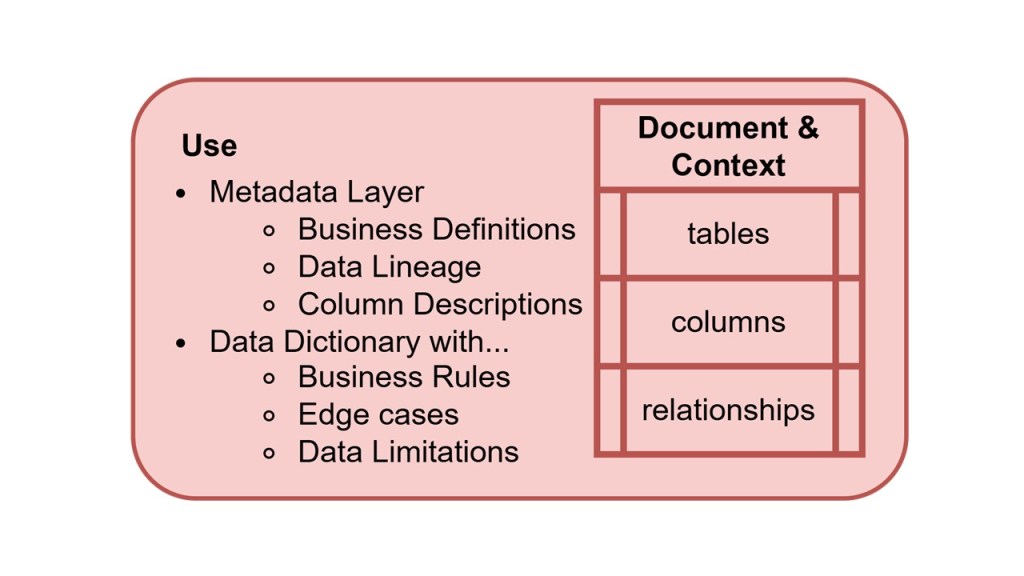
The best AI agents make heavy use of metadata to understand your data. Tools like dbt let you store business definitions, data lineage and detailed column descriptions directly alongside your models. Document what each field contains, and also why it matters to the business.
Include where the data comes from, how it’s transformed and any rules for using it. Suppose an agent knows that “customer_lifetime_value represents predicted revenue from a customer relationship over its entire duration, calculated using a 12-month lookback window.” Its answers become much more accurate and better suited to the question.
Relationship Clarity
AI agents need clearly defined relationships to join data correctly. Use proper foreign keys, and create explicit junction tables for many-to-many relationships. Don’t assume an agent will work out relationships on its own; build them into the schema.
Document the business logic behind each relationship too. For example, noting that a customer can have many orders, but each order belongs to only one customer, helps the agent aggregate data correctly.
Pre-Built Business Metrics
Don’t make AI agents recalculate complex business metrics every time. Build your most important metrics directly into the data model as views or computed columns. Examples include customer lifetime value, conversion rate and year-over-year growth.
This keeps metric calculations consistent and improves query performance. It also reduces the risk of errors when an agent tries to rebuild complicated business logic from scratch.
Ensuring Data Quality and Consistency
Validation and Standardization

AI agents perform much better with clean, standardized data. Put validation rules in place so that category values are consistent, nulls are handled predictably and data types are correct.
Use standardized reference tables for categorical data instead of free-text fields. This makes queries more efficient and helps agents understand which values are valid for each dimension.
Handling Edge Cases
Identify and resolve unusual data patterns in your model. When a specific business rule produces unexpected data, document it clearly in the metadata. Agents need to know when a standard calculation doesn’t apply.
Structural Considerations for Analytics
Strategic Denormalization
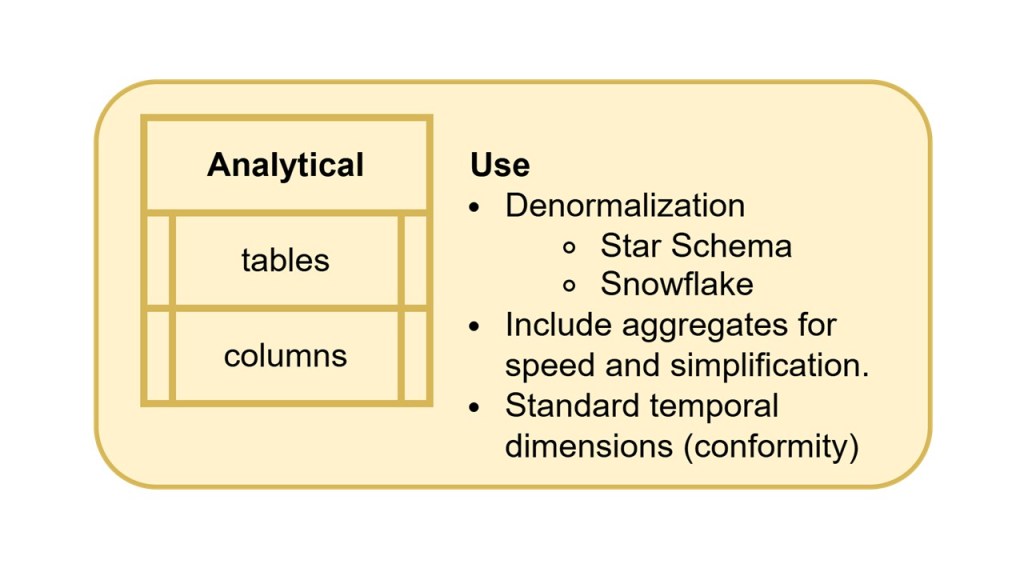
Normalized structures work well for transactional systems. For analytics, AI agents often benefit from deliberately denormalized designs. Star schemas, with a central fact table surrounded by dimension tables, keep joins simple for common analytical questions. Snowflake schemas normalize their dimensions into additional tables, so use them only where the extra structure is worth the added join complexity.
Consider building denormalized fact tables that include frequently used dimension attributes. This reduces the number of joins an agent has to get right and speeds up common queries.
Temporal Dimensions
Many business questions are about time, so time needs to be modeled explicitly. Build a complete date dimension table, and make sure every fact table has clear date or timestamp fields.
Include multiple date formats and predefined periods, such as fiscal quarters and weeks, to support different kinds of analysis. This makes it easy for AI agents to answer questions like “Compare this quarter to last quarter” or “Show me weekly trends.”
Dimensional Modeling Principles
Follow established dimensional modeling practices to create clear fact and dimension tables. Facts hold the measures you aggregate, while dimensions provide the context for grouping and filtering.
Label each measure by how it can be aggregated:
- Additive measures, such as revenue or units sold, can be summed across every dimension.
- Semi-additive measures, such as account balances or inventory levels, can be summed across some dimensions but not across time.
- Non-additive measures, such as percentages and ratios, can’t be summed at all.
These labels help agents choose the right aggregation and avoid mistakes like adding up monthly balances.
Documentation and Context
Comprehensive Data Dictionaries
Keep a detailed data dictionary that goes beyond basic definitions. Include business rules, data constraints, exceptions and data quality notes. Also record refresh frequency, how current the data is expected to be, and any known issues or limitations.
This context helps agents give better answers and add appropriate caveats when responding to exploratory questions.
Example Query Patterns
Provide example queries that show common analysis patterns in your business. These examples show agents how your organization typically retrieves, joins and aggregates data.
Include both simple lookups and complex analyses that reflect the real questions your team asks.
Business Logic Documentation

Explain the business processes behind calculated fields and derived data. Include formulas, any special handling rules and the reasoning behind specific calculation choices. With this, agents can explain how a number was calculated, not just report the result.
The Path Forward
Building data models for AI agents goes beyond traditional database design. The goal is a model that is technically sound and rich in meaning, so AI agents understand the business context behind your data.
Start with clear naming and rich metadata. Next, define relationships explicitly and build in your key business metrics. Invest in data quality and accuracy, and document the business reasoning behind your design decisions.
Careful data modeling pays off in better, more relevant AI-generated insights. As natural language analytics becomes more common, organizations with well-structured, well-documented data models will get more value from their data than competitors who skip this work.
Remember: a data model is more than a technical specification. It’s the foundation that lets AI agents connect human questions to data-driven answers. Design it with that connection in mind.
Frequently Asked Questions
What is data modeling for AI?
Data modeling for AI is the process of structuring and documenting data so that AI agents and natural language analytics tools can understand it. It combines traditional schema design with a semantic layer of business definitions, relationships, metrics and context. The goal is for an AI agent to map a plain-English question to the right tables and calculations without human help.
Why do AI agents need a different data model than traditional BI?
Traditional BI relies on analysts who already know what the tables mean, how to join them and which business rules apply. AI agents don’t have that institutional knowledge. They depend on column names, metadata and documentation to infer meaning. A data model that works fine for human analysts can produce wrong or misleading AI answers if its names are cryptic and its logic is undocumented.
What is a semantic layer, and why does it matter for AI?
A semantic layer is a business-friendly definition layer that sits on top of raw data. It describes what each table, column and metric means, how entities relate and how key figures are calculated. For AI agents, it works as a translation guide between human language and database structure, which greatly improves query accuracy and consistency. Tools such as dbt let you define much of it alongside your models.
How should I name tables and columns for AI agents?
Use full, descriptive names that match the words business users actually say, such as customer_acquisition_cost instead of cac or order_date instead of ord_dt. Apply one naming convention everywhere (for example, snake_case) and use consistent prefixes like dim_ for dimension tables and fact_ for fact tables. Clear, predictable names are the single biggest factor in helping an agent find the right data.
Should data models for AI be normalized or denormalized?
For analytics, AI agents generally perform better with dimensional, partly denormalized models such as star schemas. Fewer joins mean fewer chances for the agent to join tables incorrectly, and queries run faster. Keep normalized structures in transactional systems, and give AI agents an analytics layer of fact tables surrounded by well-described dimension tables.
Why should business metrics be pre-built into the data model?
When metrics like customer lifetime value, conversion rate or year-over-year growth are defined once as views or computed columns, every AI-generated answer uses the same approved calculation. If agents calculate complex metrics from scratch each time, results can vary between questions and conflict with official reports. Pre-built metrics improve accuracy, consistency and trust.
What are additive, semi-additive and non-additive measures?
Additive measures, such as revenue or units sold, can be summed across every dimension. Semi-additive measures, such as account balances or inventory levels, can be summed across some dimensions but not across time. Non-additive measures, such as percentages and ratios, can’t be summed at all. Labeling measures this way tells AI agents which aggregation to use and prevents errors like adding up monthly balances.
How does data quality affect AI-generated analytics?
AI agents repeat whatever is in the data. Inconsistent category values, unpredictable nulls and free-text fields lead to inaccurate or incomplete answers. Standardized reference tables, validation rules and documented edge cases help agents understand valid values and recognize when a standard calculation doesn’t apply. Clean, well-documented data is a prerequisite for trustworthy natural language analytics.
What documentation helps AI agents answer questions accurately?
The most useful documentation is a data dictionary with business definitions, refresh frequency and known limitations. Add written business logic for calculated fields, relationship descriptions and example queries that reflect the questions your team actually asks. Example queries are especially valuable because they show the agent the retrieval and aggregation patterns specific to your organization.
Where should I start when making my data model AI-ready?
Start with the steps that have the most impact and are easiest to do: rename cryptic tables and columns, then add descriptions and business definitions to your most-queried models. Next, make relationships explicit and define your five to ten most important business metrics centrally. After that, invest in data quality checks, a complete date dimension and example query libraries.






Leave a Reply