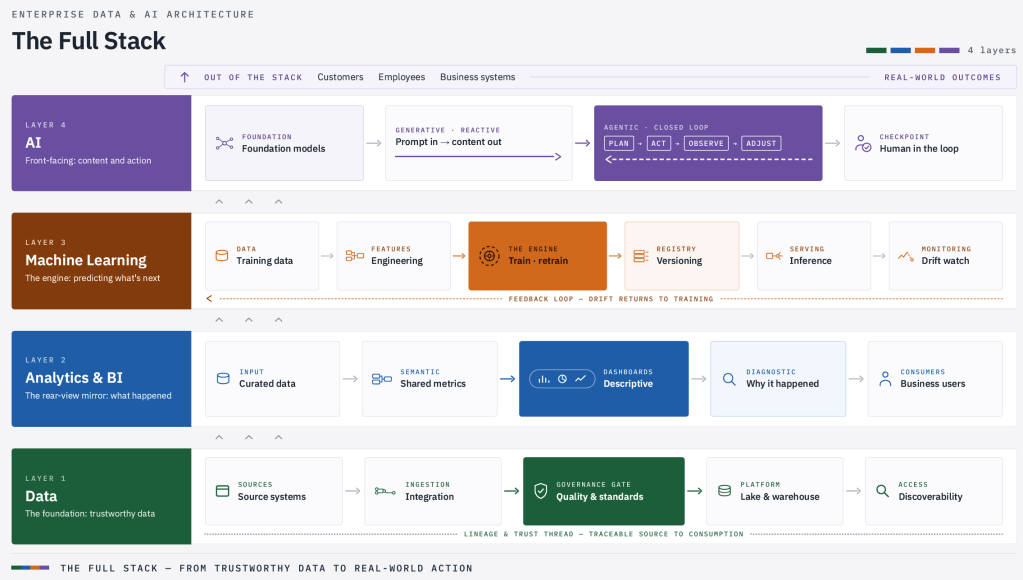
A Chief Data, Analytics, and AI Officer (CDAIO) is the single executive accountable for turning an organization’s data into business value through analytics, machine learning, and AI. The Data-to-AI Framework defines that scope as four stacked layers, where each layer depends on the one beneath it:
- Enterprise Data Management: the foundation. Every model, dashboard, and decision is only as reliable as the data underneath it.
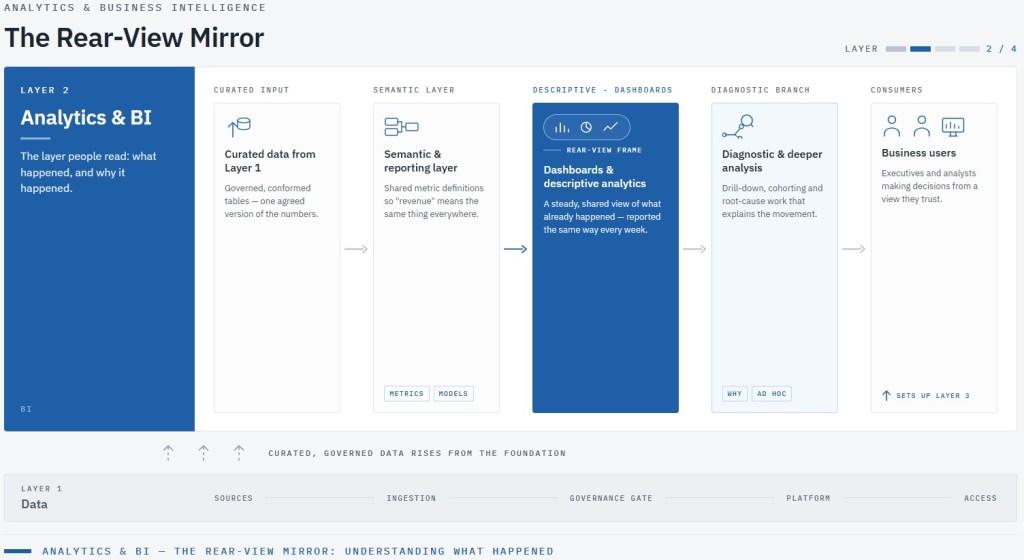
- Analytics & Business Intelligence: the rear-view mirror that shows what happened and why it happened.
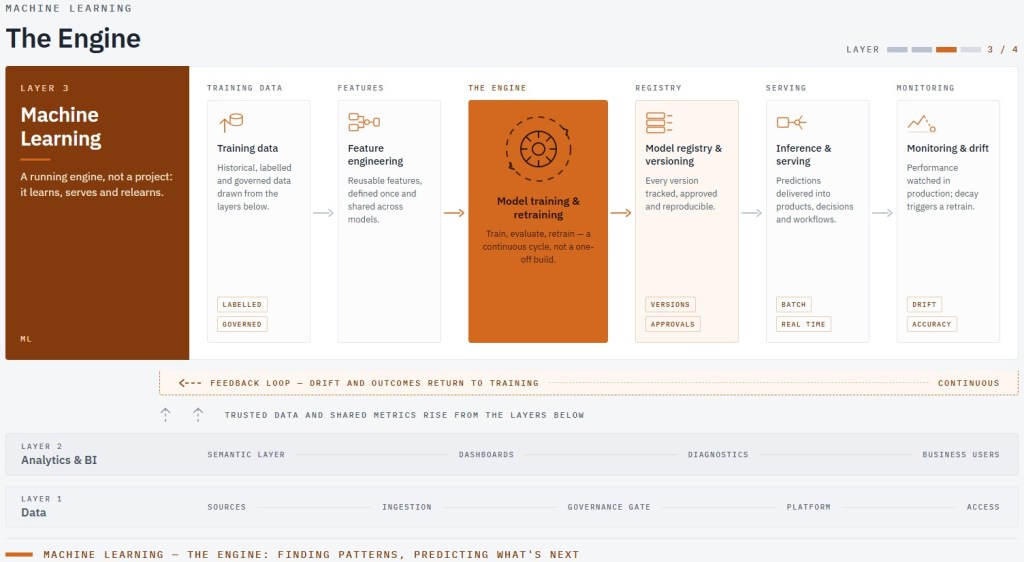
- Machine Learning: where patterns become predictions and predictions become an advantage.
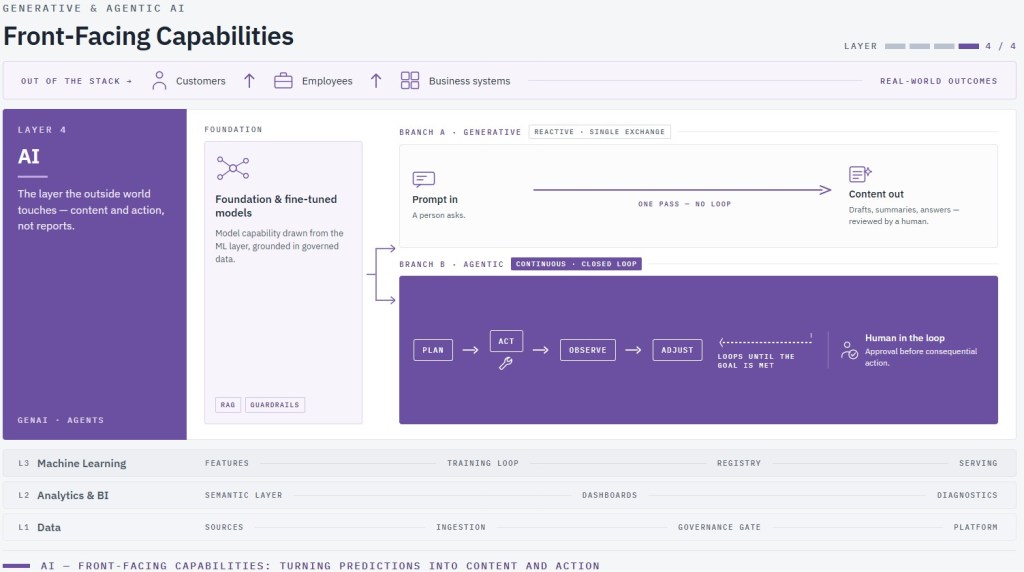
- Generative & Agentic AI: the front-facing layer that turns insight into content, decisions, and action.
Each of the four layers matures through four levels, and maturity is earned from the bottom up. Enterprise Data Management moves from ingestion and integration, through quality, modeling, and governance, to access and discoverability, and finally to strategic data and document assets. Analytics & BI progresses from descriptive to diagnostic, predictive, and prescriptive optimization. Machine Learning advances from predictive models to advanced ML systems, process automation, and ML-driven decisioning. Generative & Agentic AI grows from NLP and computer vision basics, to GenAI applications, to multi-agent orchestration, and ultimately to autonomous systems governed at scale. Because each layer stands on the ones below, weak foundations show up as a “foundation tax” higher in the stack, such as ML engineers cleaning data or AI pilots stalling before production. The job of a CDAIO is to know where each layer truly stands and to invest in the next level only where value is proven and the foundation is ready.
Beneath all four sits a business foundation: strategic alignment, governance and sponsorship, organizational readiness, and a data-driven culture.
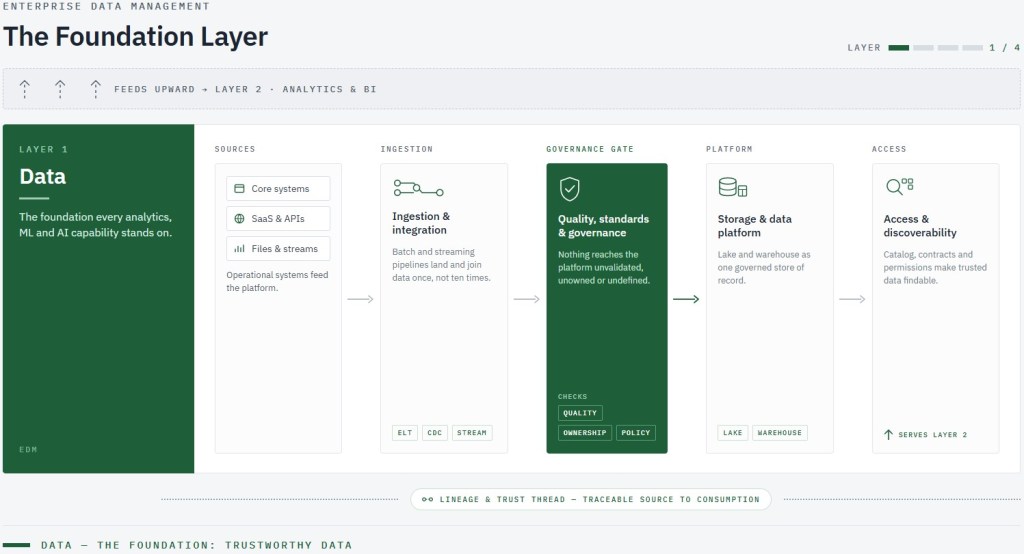
Enterprise Data Management: The Foundation for Trustworthy BI, ML, AI
Every model, dashboard, and decision is only as reliable as the data underneath it.
Analytics and Business Intelligence: Turning Raw Data into Decision-Ready Insights
The rear-view mirror that shows what happened and why it happened.
Machine Learning Architecture: The Engine Behind Predictive and Prescriptive Analytics
Where patterns become predictions and predictions become an advantage.
Generative and Agentic AI: From Predictions to Autonomous Business Actions
The front-facing layer that turns insight into content, decisions, and action.
FAQ
What is the Data-to-AI Framework?
The Data-to-AI Framework is a four-layer maturity model for building enterprise data and AI capability:
- Enterprise Data Management
- Analytics & BI
- Machine Learning
- Generative & Agentic AI
Each layer builds on the one below it. Within each layer, capability moves from foundational to strategic, for example from descriptive to prescriptive analytics, or from GenAI applications to autonomous systems.
What is a Chief Data, Analytics, and AI Officer (CDAIO)?
A CDAIO is the executive accountable for the whole data-to-AI stack. That runs from how data is ingested, governed, and made accessible, through the dashboards and analytics people use to make decisions, to the machine learning models and AI applications that act on them. The role is measured on business value, not on technology delivery alone.
How is a CDAIO different from a CDO or a Chief AI Officer?
A Chief Data Officer traditionally focuses on the foundation: governance, quality, and compliance. A Chief AI Officer usually focuses on the top layer. A CDAIO owns both and everything in between. That matters because AI can’t outperform the data, metrics, and models underneath it.
Why should one leader own data, analytics, ML, and AI?
Because the layers depend on each other:
- Dashboards need governed data.
- ML models need trusted features and shared metric definitions.
- AI applications need production-grade models and grounded data.
When separate leaders own separate layers, you get hand-offs, duplicate platforms, and unclear accountability when something fails. One owner means one roadmap, one platform strategy, and one person answerable for results.
What does a CDAIO own in each layer?
- Enterprise Data Management: ingestion, data quality, governance, and access.
- Analytics & BI: the semantic layer, shared metrics, and trusted reporting.
- Machine Learning: training, model registry, serving, and drift monitoring.
- Generative & Agentic AI: retrieval-augmented generation (RAG), guardrails, and human-in-the-loop controls.
Across all four layers, the CDAIO also owns the business foundation: strategic alignment, sponsorship, organizational readiness, and a data-driven culture.
Can an organization skip straight to generative AI?
Not sustainably. Generative AI depends heavily on documents and other unstructured content, and that content needs the same care as structured data: ownership, quality checks, and access controls. AI built without governed data, shared metrics, and monitored models tends to stall at the pilot stage. Layer 4 is only as reliable as Layers 1 through 3 beneath it.
Where should a new CDAIO start?
With the business foundation and Layer 1. First, confirm strategic alignment and executive sponsorship. Then assess data ingestion, quality, governance, and access. Gaps there limit everything built on top. Next, tie each layer’s roadmap to a specific business outcome, so data investments show value through the analytics, ML, and AI use cases they make possible.
How do you measure whether a CDAIO is succeeding?
By business outcomes, not activity. Useful signals include:
- trust in and adoption of shared metrics
- how many models are running in production and being monitored, rather than stuck in pilots
- how quickly use cases move from idea to deployment
- measurable impact on revenue, cost, or risk
Leadership should review these at least quarterly.
Where should the CDAIO sit in the organization?
Close to the business. The role exists to create value from data and AI, so it works best when it reports to a leader who owns business outcomes or transformation, not only IT operations. A technology reporting line can work when that leader is focused on business transformation rather than on running systems.