

After leading over 80 data and AI engagements, I’ve learned that the most critical factor determining project success isn’t the sophistication of your algorithms or the complexity of your data model. It’s how well you understand and articulate your business objectives from the very beginning.
Too often, organizations rush into Data or AI projects with enthusiasm but without direction. They know they want to “leverage AI” or “become more data-driven,” but they haven’t done the foundational work of defining what success actually looks like. This is where projects derail before they even begin.
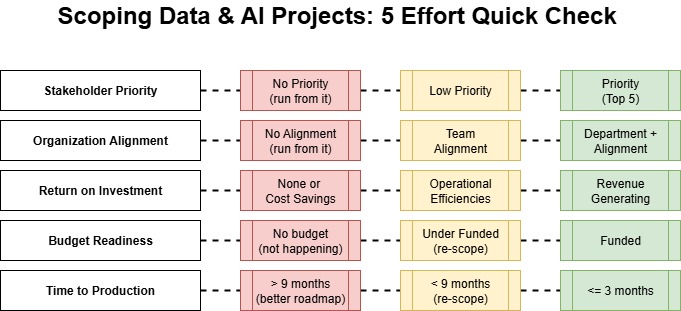
Getting to the Real Problem: Beyond “We Need Insights”
The first challenge in any Data or AI initiative is distinguishing between symptoms and root causes. When stakeholders say they need predictive analytics or machine learning, they’re often describing a solution rather than the problem they’re trying to solve.
Effective scoping starts with articulating the problem. Instead of accepting “we need AI for customer retention,” dig deeper. What specific retention challenges are you facing? Are customers churning after their first purchase, or are long-term customers gradually disengaging? Are retention issues consistent across all segments, or concentrated in specific demographics?
Techniques like the “5 Whys” can be invaluable here. Keep asking “why” until you uncover the fundamental business problem that needs solving. This process often reveals that the real issue might be different from what was initially presented, potentially requiring a completely different approach than originally envisioned.
Aligning Stakeholders Around Shared Objectives
One of the biggest obstacles to successful Data and AI projects is conflicting objectives across stakeholders. The marketing team wants to increase customer lifetime value, the operations team wants to reduce costs, and the executive team wants to improve quarterly metrics. Without alignment, your project will be pulled in multiple directions.
Effective stakeholder alignment requires mapping both primary and secondary stakeholders, understanding their individual goals, and identifying where those goals might conflict. Conducting structured discovery sessions with business users helps surface these tensions early, when they can still be addressed through scope refinement rather than mid-project pivots.
Documentation is crucial here. Create clear requirements templates that capture not just what stakeholders want, but why they want it and how they’ll measure success. This documentation becomes your north star throughout the project lifecycle.
Defining Success Before You Start
Perhaps the most critical aspect of understanding project objectives is translating abstract business goals into concrete, measurable outcomes. “Improve customer satisfaction” isn’t actionable, but “increase Net Promoter Score by 15 points within six months” is.
This requires establishing baselines and conducting a thorough current state assessment. You can’t measure improvement if you don’t know where you’re starting from. Define both leading indicators (early signals of progress) and lagging indicators (ultimate outcomes) to create a comprehensive measurement framework.
For AI projects specifically, consider ROI frameworks that account for both quantitative benefits (cost savings, revenue increases) and qualitative improvements (employee satisfaction, decision-making speed). These frameworks help justify continued investment and demonstrate value to skeptical stakeholders.
Understanding Strategic Context
Data and AI projects don’t exist in isolation. Understanding where your initiative fits within the broader business strategy is essential for proper scoping and resource allocation. Consider competitive pressures, regulatory requirements, and organizational priorities that might influence project direction or timeline.
This strategic context also informs risk tolerance assessment. A project supporting a new market entry might justify higher risk and faster timelines than one optimizing existing operations. Understanding these nuances helps you scope appropriately and set realistic expectations.
The Cost of Poor Objective Setting
In my experience, projects that skip this foundational work face predictable challenges: scope creep, stakeholder dissatisfaction, technical solutions that don’t address business needs, and ultimately, projects that are technically successful but commercially irrelevant.
The time invested upfront in truly understanding objectives and business goals pays dividends throughout the project lifecycle. It provides clarity for technical decisions, helps prioritize features, and creates alignment that sustains momentum through inevitable challenges.
Moving Forward
Before diving into data sources, technology requirements, or team structures, ensure you’ve done the hard work of understanding what you’re actually trying to achieve. Ask tough questions, document everything, and don’t move forward until you have genuine alignment around objectives.
Remember: the best Data and AI implementation in the world won’t save a project with unclear business objectives. But a well-scoped project with clear goals has a fighting chance at delivering real business value, regardless of technical complexity.
The foundation matters. Build it well, and everything else becomes possible.
Join my presentation at SQL Saturday MN on 9/27/2025 SQL Saturday Minnesota 2025 (#1124)




 Ross McNeely
Leave a reply to The Data Detective: How Quality Assessment Shapes Successful Data and AI Project Scoping – Ross McNeely Cancel reply