Building Enterprise AI on a Foundation of Shared Business Meaning
For Data Architects, the pressure has never been greater. Business stakeholders want conversational AI that understands their domain. Compliance teams need governed, auditable data access. Engineers need semantic consistency across lakehouses, warehouses, and real-time streams. Microsoft Fabric IQ is Microsoft’s platform to support those capabilities, and it has direct implications for how you design, govern, and evolve your enterprise data architecture.
This post breaks down what Fabric IQ is, how its components work together, and what it means for your architectural decisions.
What is Microsoft Fabric IQ?
Fabric IQ is a workload within Microsoft Fabric focused on unifying data from across OneLake and organizing it according to the language of your business. The result is a consistent semantic layer that is shared across analytics tools, AI agents, and business applications.
The key word here is unified. Fabric IQ does not create new silos. It surfaces and connects existing data assets like Lakehouses, Eventhouses, Power BI semantic models under a shared vocabulary. Business concepts like Customer, Order, or Shipment are defined once and interpreted consistently wherever they are used. (What is Fabric IQ)
Architect Insight: Fabric IQ is not a replacement for your existing data stores. It is a semantic coordination layer built on top of them. Plan your adoption around your existing OneLake footprint and Semantic Models because both can serve as ontology bootstrap sources.
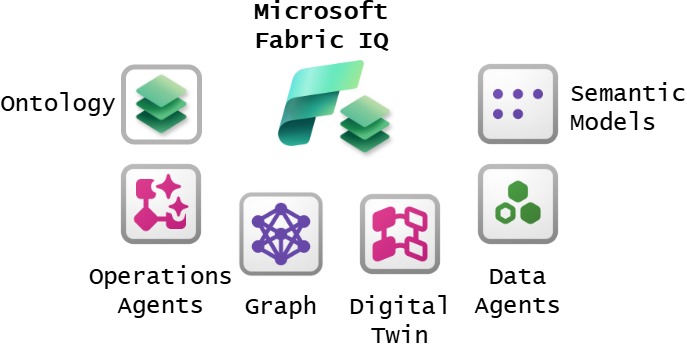
The Five Items in Fabric IQ
Fabric IQ is composed of five items. Some are exclusive to IQ; others are shared with workloads like Real-Time Intelligence and Power BI. Understanding each item, and how they interact is essential for architectural planning.
| IQ Item | Purpose | Architect Consideration |
| Ontology | Enterprise vocabulary and semantic layer; defines entity types, relationships, properties, and rules bound to real data. | Design cross-domain consistency and AI grounding. Align with governance and business glossaries. |
| Graph | Native graph storage and compute for nodes, edges, and traversals. Enables path-finding, dependency analysis, and graph algorithms. | Model complex relationship chains. Plan for integration with ontology for visual, queryable business concept maps. |
| Data Agent | Conversational Q&A system using generative AI, connected to ontology and structured/unstructured data sources. | Govern agent scope with source-level instructions and RLS/CLS policies. Evaluate for business user rollout. |
| Operations Agent | AI agent that monitors real-time data and recommends or triggers governed business actions. | Identify real-time monitoring use cases. Design action governance and audit trails. |
| Semantic Model | Curated Power BI analytics model with measures, hierarchies, and DAX. Can seed ontology creation. | Treat existing semantic models as ontology bootstrap candidates. Maintain terminology alignment. |
These items are not required to be deployed together. Fabric IQ is designed to be adopted incrementally, and items from other Fabric workloads are shared rather than duplicated.
Why This Matters for Data Architecture
Data Architecture has always been concerned with three layers: outcomes (models and definitions), activities (design and deployment), and behavior (collaboration and governance). Fabric IQ touches all three.
Outcomes: An Enterprise Model… Building Ontologies in Fabric IQ will solve the Enterprise domain definitions by declaring entity types, their relationships, properties, and constraints once and binding them to real data in OneLake.
Activities: Bridging Current State to Future State… A core Data Architecture activity is gap analysis by identifying the current state and a targeted future architecture. Fabric IQ can be bootstrapped directly from existing Power BI semantic models, which means architects can being with what already exists rather than designing from scratch.
Behavior: Governance, Trust, and Cross-Domain Reasoning… Fabric IQ is built with governance as a first-class concern. Ontology definitions reduce duplication across teams. Constraints within the ontology improve data quality, and enforce access permissions.
How the Items Work Together
The IQ workload is designed so that its items reinforce each other. The following relationships are described in Microsoft’s documentation:
- Ontology + Semantic Model: Define enterprise concepts once. Generate or align Power BI semantic models so that KPIs and terminology stay consistent across reports and agents.
- Ontology + Graph: Ontology declares which entities connect and why. Graph stores and computes traversals — for example, finding shipments exposed to risky routes and related breaches across an Order > Shipment > Temperature Sensor > Cold Chain Breach chain.
- Ontology + Data Agent: The ontology grounds the Data Agent in shared business semantics and rules. Agents retrieve context, reason across domains, and surface answers that stay within business guardrails.
- Ontology + Operations Agent: Operations Agents monitor real-time data, evaluate trade-offs, and can trigger governed actions — informed by the same ontology that drives analytics and conversational AI.
Integration with Broader Microsoft Fabric and Azure Ecosystem
Fabric IQ does not exist in isolation. Data Architects need to understand how it connects to the wider platform:
- Microsoft Copilot Studio: Data Agents can be published to Copilot Studio and deployed to Microsoft Teams, enabling business users to receive data-driven answers in their existing workflow — without requiring SQL, DAX, or KQL expertise.
- Azure AI Foundry: Data Agents connect to Foundry Agent Service using workspace and artifact IDs, with Identity Passthrough authorization. Foundry IQ provides a centralized RAG (Retrieval-Augmented Generation) workflow that respects user permissions and data classifications, with Purview-based security enforced automatically on each agent call.
- Fabric MCP Server: Agents built in Microsoft Foundry can access Fabric Data Agents through hosted Model Context Protocol (MCP) server endpoints, enabling AI development environments like VS Code to connect securely to enterprise knowledge.
- CI/CD and GitHub Integration: Data Agents can be deployed through Fabric deployment pipelines and integrated with GitHub repositories, enabling standard software delivery practices for AI assets.
Architectural Considerations and Recommendations
Based on the documented capabilities of Fabric IQ, Data Architects should consider the following as they evaluate adoption:
1. Assess Your Semantic Model Inventory
Existing Power BI semantic models can directly seed ontology creation. Begin by cataloging your current semantic models, identifying the most authoritative definitions for key business entities, and treating these as ontology candidates.
2. Define Your Ontology Governance Model
An ontology is only as valuable as its governance. Determine who owns entity definitions, what the change management process looks like, and how ontology versions will be validated before deployment. Fabric’s built-in versioning and monitoring tools support this, but the governance model must be defined at the architectural level.
3. Plan Agent Scope and Instruction Design
Data Agents require agent-level instructions and source-specific instructions. Architects should define the scope of each agent which data sources it can access, what question domains it is designed to serve, and how RLS and CLS policies will be enforced. Treat agent design as an architectural artifact, not just a configuration task.
4. Align with Your Data Management Framework
Fabric IQ touches multiple Enterprise Data Management components: Data Architecture, Data Modeling and Design, Data Security, Reference and Master Data, Metadata, Data Quality, and AI and Generative AI. Adoption decisions should be evaluated against your organization’s existing frameworks for each of these domains.
5. Communicate Across Agile Delivery
Data Architects need to ensure that Data Engineers, Data Analysts, Data Scientists, and AI Engineers understand how Fabric IQ changes the semantic layer they work with. Ontology changes have downstream effects on agents, reports, and applications. Sprint alignment and clear communication with Project Leaders and Steering Committees is essential during rollout.
Summary
Microsoft Fabric IQ represents a significant architectural evolution: from data platforms that store and process data, to intelligence platforms that understand and communicate in the language of the business. For Data Architects, this is both an opportunity and a responsibility.
The opportunity is to establish a governed, consistent semantic foundation that enables AI agents, analytics, and applications to reason from shared definitions to reducing fragmentation and increasing trust. The responsibility is to design that foundation thoughtfully with governance, with alignment to existing data assets, and with clear communication across the teams that depend on it.
Fabric IQ is currently in preview. Architects evaluating adoption should monitor Microsoft Learn documentation for updates to item capabilities, integration patterns, and general availability timelines.
 Ross McNeely
Leave a comment