
Understanding the Vertical and Horizontal Modeling of Data, Analytics, and AI Success
Every week, another organization announces a major AI initiative. Billions are being invested in artificial intelligence, machine learning, and generative AI. Yet studies show the rate these initiatives fail to deliver meaningful business value. The culprit is not technology, but instead it is a fundamental misunderstanding of how data, analytics, and AI capabilities must be built.
The Trap of Advanced Technology
The problem is deceptively simple. Organizations are attempting to implement cutting-edge AI capabilities without first establishing the foundational data and analytical infrastructure required to support them. It is the equivalent of trying to fly before constructing the wings.
This failure is not random. It is systematic, predictable, and entirely avoidable. The solution lies in understanding two critical dimensions that govern success in data, analytics, and ML/AI: vertical stratification (the sequential capability layers you must build) and horizontal value chains (the progression from foundational to strategic value within each layer).
The Stratification Principle: Why You Cannot Skip Layers
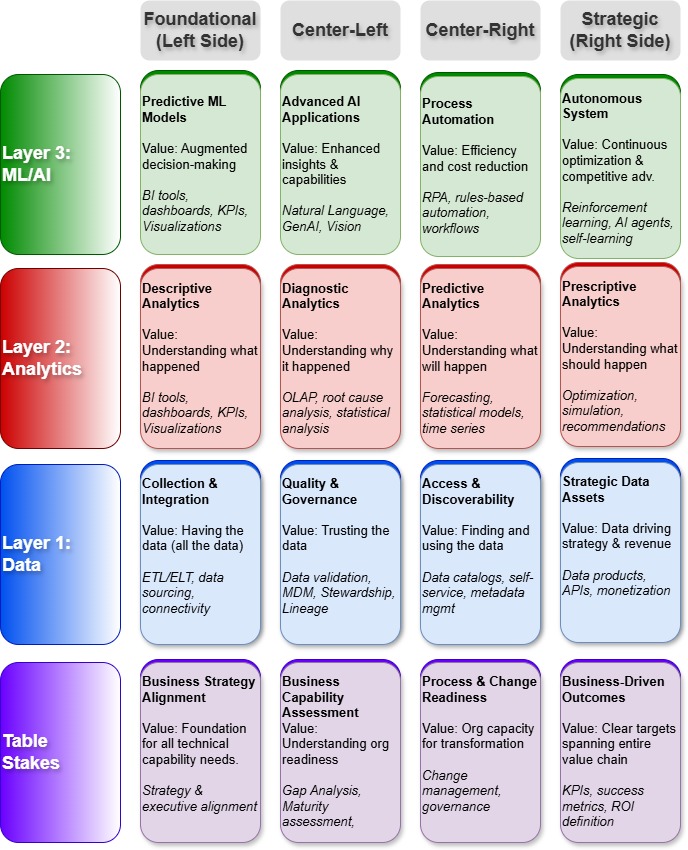
Think of data, analytics, ML, and AI as four parts of a plane. Each part must be constructed in order:
- Layer 0: Business Foundation – Strategy, capability needs, and org readiness
- Layer 1: Data – From collection and quality to strategic data assets
- Layer 2: Analytics – From descriptive reporting to prescriptive optimization
- Layer 3: ML/AI – From forecasting to generative capabilities
The Stratification Principle is unforgiving. Organizations that attempt to implement AI capabilities without first establishing robust data foundations and analytical maturity will experience systematically higher failure rates, longer time-to-value, and lower ROI than those that build capabilities in sequential layers.
This is not theoretical. When a company deploys a sophisticated machine learning model on top of poor-quality, ungoverned data, the model does not magically fix the data problems, but instead it amplifies them. Garbage in, garbage out remains the fundamental law, no matter how advanced your algorithms.
The Value Chain Principle: Why Foundational Work Matters
Within each layer, there is a horizontal progression from foundational capabilities on the left to strategic, high-value capabilities on the right. This is where many organizations make their second critical mistake by attempting to leap to the right side of the value chain without mastering the left.
The Data Layer Value Chain
- Collection and Integration (Foundational Left): Having the data
- Quality and Governance (Center-Left): Trusting the data
- Access and Discoverability (Center-Right): Finding and using the data
- Strategic Data Assets (Strategic Right): Data driving strategy and revenue
The Value Chain Progression Principle states that business value increases non-linearly as organizations progress from foundational to strategic capabilities. More importantly, organizations that prematurely attempt high-value capabilities without mastering foundational ones will encounter insurmountable technical debt and organizational resistance.
The Interdependency Map: Understanding What Depends on What
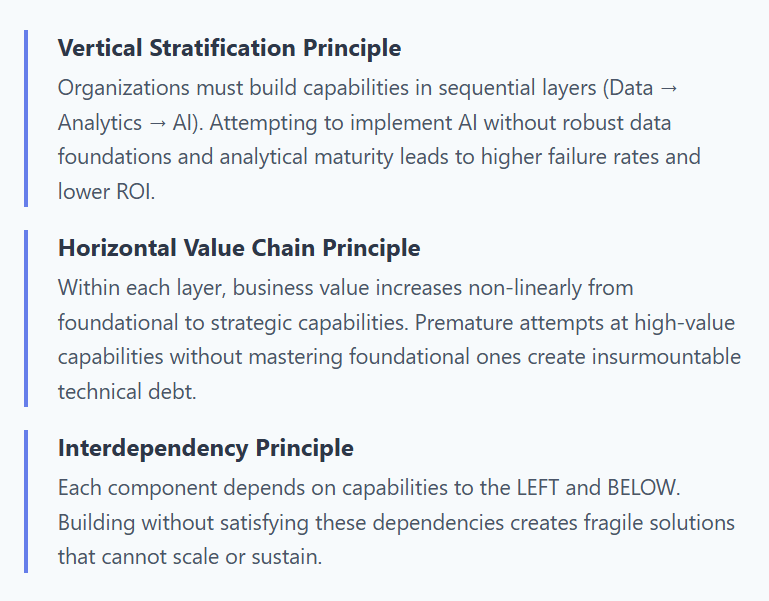
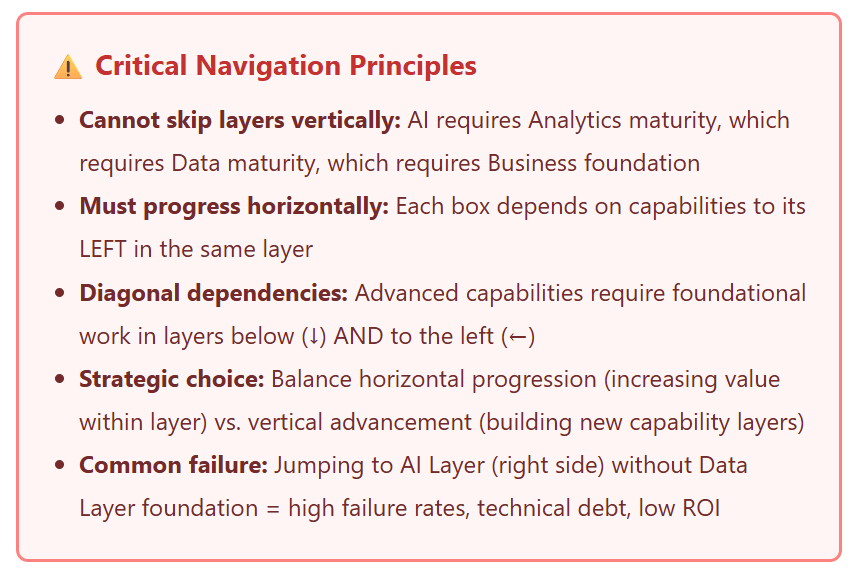
Each component in the matrix has dependencies on capabilities to its left (same layer) and below (previous layers). Attempting to build capabilities without satisfying these dependencies creates fragile solutions that cannot scale or be sustained.
Example: You want to implement predictive analytics (center-right of the Analytics layer). This requires:
- Below: Clean, comprehensive, integrated data from the Data layer
- Left: Mastery of descriptive and diagnostic analytics in your Analytics layer
- Further Below: Business strategy alignment and organizational readiness from the Business Foundation
The Hidden Enemy: Business-Technical Misalignment
Even when organizations understand the technical stratification and value chains, they often fail due to business-technical misalignment.
Pattern 1: Technical Capability Outpaces Business Readiness
The IT department successfully implements advanced AI systems, but the business lacks the processes, governance, or organizational change capacity to use them effectively. Result: underutilized investments.
Pattern 2: Business Ambitions Exceed Technical Maturity
Leadership demands advanced AI capabilities without investing in the foundational data and analytics work. Result: failed pilots, stakeholder disillusionment, and strategic paralysis.
An organization’s ability to extract value from data, analytics, and AI is more strongly correlated with internal organizational factors as governance maturity, data literacy, cross-functional collaboration, leadership alignment, and change management capacity than with the sophistication of the technology deployed.
The Navigation Dilemma: Horizontal vs. Vertical Progression
Organizations face continuous strategic choices: Should you progress horizontally (increasing value within your current layer) or vertically (building the next capability layer)?
General Principle: Organizations that master foundational capabilities in each layer before advancing will experience faster value realization, lower total cost of ownership, and greater strategic agility than those that pursue multiple advanced capabilities simultaneously or skip foundational work.
The AI Layer: Where Most Organizations Get It Wrong
Process Automation (Left Side)
RPA, rules-based automation, workflow optimization. This is foundational AI—not glamorous, but essential.
Predictive ML Models (Center-Left)
Classification, regression, pattern recognition. Requires predictive analytics foundation from the layer below.
Advanced AI Applications (Center-Right)
NLP, computer vision, recommendation systems, GenAI applications. Requires mature analytics and data products.
Autonomous Systems (Right Side)
Self-learning systems, autonomous decision-making. Requires ALL previous capabilities to be mature.
The Pattern of Failure: Organizations see competitors showcasing autonomous AI systems and immediately attempt to deploy similar capabilities. But they lack the foundational layers, and the project fails.
What Success Looks Like: The Strategic Roadmap
- Step 1: Assess Current Position – Map where you are across all layers and value chain stages. Be brutally honest.
- Step 2: Define Target State – Based on business strategy, determine where you need to be.
- Step 3: Identify Dependencies – For each target capability, map the required foundations.
- Step 4: Make the Horizontal vs. Vertical Decision – Decide whether to deepen current capabilities or build the next layer.
- Step 5: Build Foundational Capabilities First – Resist jumping to advanced capabilities. Master the fundamentals.
- Step 6: Balance Quick Wins with Long-Term Investment – Include quick wins alongside foundational investments.
Common Anti-Patterns to Avoid
- The Layer Jumper: Attempting to implement AI without building data and analytics foundations.
- The Left-Side Dweller: Building excellent foundational capabilities but never progressing to strategic work.
- The Scattered Builder: Pursuing multiple advanced initiatives simultaneously without deliberate sequencing.
- The Technology-First Organization: Deploying sophisticated technology without corresponding business capability investments.
The Path Forward: Strategic Clarity in a Complex Landscape
The data, analytics, and AI landscape is genuinely complex. New technologies emerge constantly. The pressure to do something… anything… is intense.
But technological sophistication alone cannot guarantee success. What determines success is a deliberate approach that builds vertically through sequential capability layers and progresses horizontally through value chains that align with business maturity.
The organizations that will win with data, analytics, and AI are not those with the most advanced technology. They are the organizations with the discipline to build complete foundations, the clarity to understand dependencies, and the strategic wisdom to progress deliberately rather than impulsively.
The question is not whether to invest in data, analytics, and AI. The question is: Will you build on solid ground, or will you keep trying to fly wingless planes?
 Ross McNeely
Leave a comment