
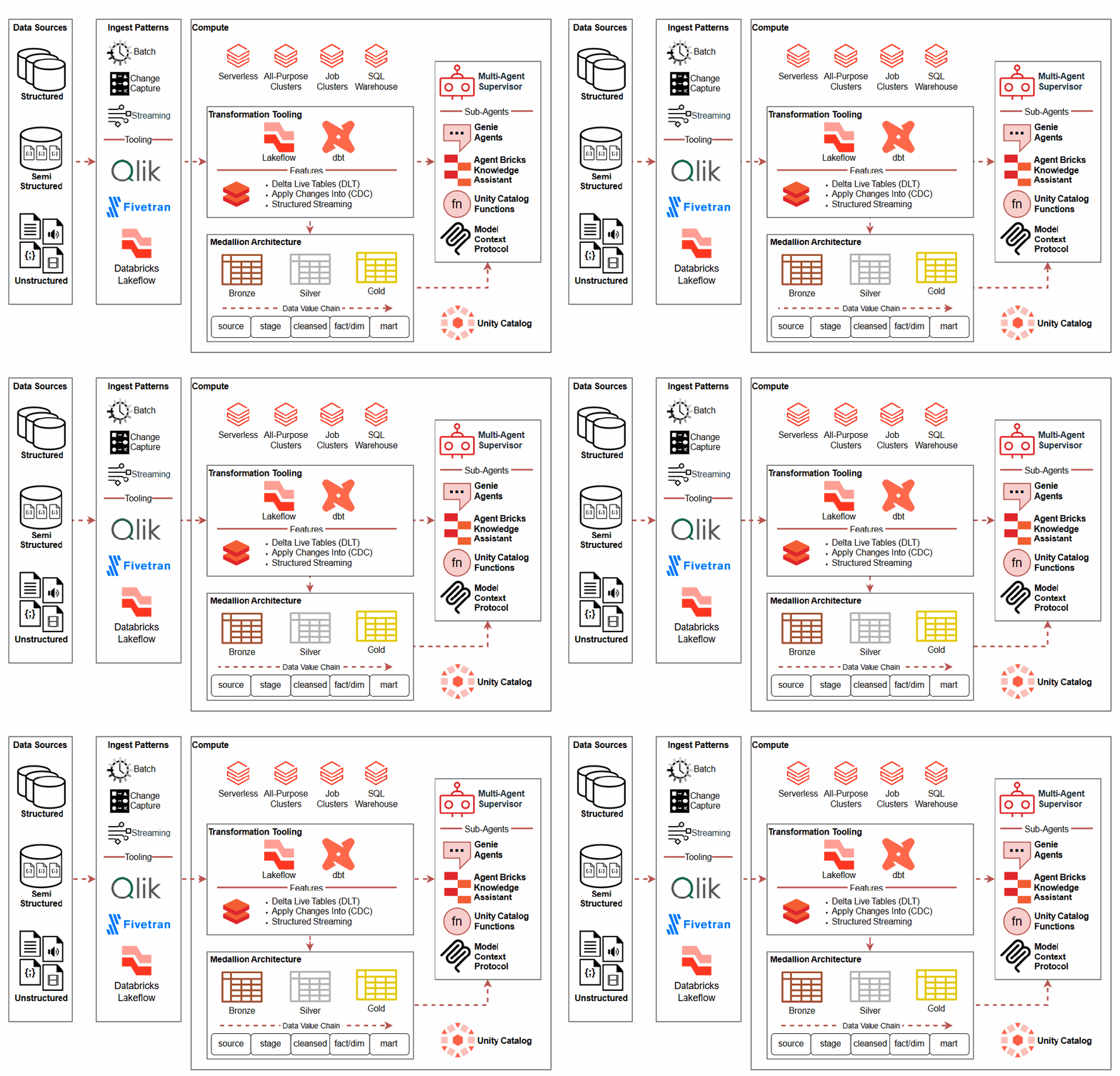
Enterprise AI has evolved beyond simple chatbots answering single questions. Modern organizations need AI systems that can handle complex queries spanning multiple data sources, domains, and knowledge types. The Databricks Multi-Agent Supervisor addresses this challenge by orchestrating specialized AI agents into a coordinated system that delivers comprehensive, accurate responses while maintaining enterprise grade governance.
Coordinated Agents
Multi-Agent Supervisor represents a fundamental shift in how we build AI systems. Instead of creating one massive agent that tries to do everything, it coordinates specialized sub agents, each excelling in its specific domain. Think of it as assembling an expert team where each member brings unique capabilities. The supervisor intelligently routes tasks to the right specialists, manages their interactions, and synthesizes their outputs into unified answers.
This architecture solves real business problems. Consider a financial services company analyzing market conditions. A single query like “How export restrictions affect our portfolio?” requires accessing structured data, unstructured policy documents, and internal strategy memos. Multi-Agent Supervisor coordinates these different information sources seamlessly, delivering insights that no single agent could provide alone.
Four Essential Building Blocks
Multi-Agent Supervisor orchestrates four types of specialized agents, each serving distinct enterprise needs.

Genie Spaces/Agents
Agent Bricks: Knowledge Assistant
Unity Catalog Functions
Model Context Protocol
Genie Spaces: Your Data Analytics Partner
Genie Spaces transform natural language questions into precise SQL queries against your structured data. Business users can ask “What were our top performing products last quarter?” and Genie converts this into optimized SQL, executes it against your data warehouse, and returns visualizations.
What makes Genie powerful is its understanding of your business context. Domain experts configure Genie Spaces with metadata, example queries, and business rules specific to your organization. When integrated into a Multi-Agent Supervisor system, Genie handles all queries requiring quantitative analysis, freeing other agents to focus on their specialties. The supervisor automatically routes data driven questions to the appropriate Genie Space while ensuring users only access data they have permissions to see.
Knowledge Assistant: Enterprise Document Intelligence
Knowledge Assistant endpoints provide RAG (Retrieval Augmented Generation) over your document repositories. This agent excels at answering questions from manuals, policies, technical documentation, and other unstructured content.
Unlike generic document search, Knowledge Assistant is purpose built for enterprise quality requirements. It provides citations for every response, pointing users to exact source documents. Subject matter experts can continuously improve its performance through natural language feedback, teaching the agent your organization’s specific terminology and expectations. When the Multi-Agent Supervisor receives qualitative questions requiring document analysis, it delegates to Knowledge Assistant, which retrieves relevant content and generates accurate, cited responses.
Unity Catalog Functions: Custom Business Logic
Unity Catalog Functions bring deterministic business logic into your AI system. These are custom Python or SQL functions that encode specific calculations, data transformations, or business rules unique to your organization.
Perhaps you have complex pricing algorithms, compliance checks, or data validation routines that must execute exactly as written. Unity Catalog Functions let you package this logic as callable tools. The Multi-Agent Supervisor can invoke these functions when tasks require precise, reproducible computations. Since these functions live in Unity Catalog, they inherit the same governance, permissions, and lineage tracking as your data assets.
MCP: Connecting to External Systems
The Model Context Protocol opens Multi-Agent Supervisor to the broader ecosystem. MCP servers can connect to external services, third party APIs, or internal systems beyond Databricks. Whether it is GitHub for code operations, Slack for communications, or proprietary company systems, MCP provides standardized integration.
Databricks offers managed MCP servers with built in security and authentication. You can also install servers from Databricks Marketplace or host custom MCP servers as Databricks Apps. The supervisor treats these external tools as additional specialists, routing appropriate tasks while Unity Catalog maintains governance over access and permissions.
How It Works in Practice
Multi-Agent Supervisor operates through advanced orchestration patterns. When a user submits a complex question, the supervisor analyzes the request, decomposes it into sub tasks, and routes each to the most qualified agent. It manages the conversation flow, sharing context between agents when needed, and synthesizes partial results into complete answers.
The entire system operates through a single endpoint accessible via Playground or integrated into applications through Databricks Apps. Built in access controls ensure that users only interact with data and tools they are authorized to access. All agent interactions are automatically traced through MLflow, providing full observability into how the system reached its conclusions.
What makes this approach particularly powerful is the ability to improve the system through human feedback. Subject matter experts can review agent responses, provide natural language corrections, and the supervisor learns from this feedback to make better routing and coordination decisions over time.

Why This Architecture Matters
Organizations adopting Multi-Agent Supervisor report significant improvements in both development speed and solution quality. Companies use it to consolidate internal reports and external market data, creating unified analysis capabilities across diverse data sources managed by different teams. The no code approach means data analysts and business users can assemble sophisticated AI systems without extensive engineering.
The architecture scales with your needs. Start with two or three specialized agents, then add more as requirements grow. Each new agent extends the system’s capabilities without disrupting existing functionality. Since all agents share Unity Catalog governance, you maintain consistent security and compliance regardless of complexity.
For enterprises struggling with siloed data and fragmented AI tools, Multi-Agent Supervisor provides the coordination layer that ties everything together. Users get a single conversational interface that intelligently leverages all your organization’s knowledge, while you maintain the governance and observability that production AI systems demand.
The future of enterprise AI is not about building bigger single agents. It is about orchestrating specialized intelligence into systems that mirror how expert teams actually work. Multi-Agent Supervisor makes that vision operational today, letting you deploy production ready AI that truly understands and acts on your business context.
 Ross McNeely
Leave a comment