
After working with organizations on data and AI engagements, one pattern emerges consistently… the projects that succeed aren’t necessarily those with the most sophisticated algorithms or the largest datasets. They’re the ones that establish clear timelines and measurable success criteria from day one.
Whether you’re tackling customer retention challenges or optimizing operational workflows, the difference between transformative results and abandoned initiatives often comes down to how well you plan and measure progress. Let’s dive into the practical frameworks that turn abstract Data and AI concepts into tangible business outcomes.

Building Realistic Timelines: The Phased Delivery Advantage
Breaking Down Complexity Into Manageable Phases
Complex data and AI projects can feel overwhelming, but the solution isn’t to oversimplify. It’s to break them into digestible phases that build momentum and deliver value incrementally.
The Four-Phase Framework:
- Discovery Phase: Understanding the problem, assessing data availability, and validating assumptions
- Proof-of-Concept: Building a minimal viable solution to test core hypotheses
- Pilot Implementation: Testing the solution with a limited user base or dataset
- Production Deployment: Full-scale implementation with monitoring and optimization
Each phase should have clear go/no-go decision points. This isn’t just project management theater. This is how you build your safety net. I’ve seen organizations save hundreds of thousands of dollars by making the tough call to pivot or stop after the proof-of-concept phase revealed fundamental issues with their approach. (Often data quality issues)
Building in the Right Buffers
Here’s what most project plans miss: data preparation and model iteration cycles take longer than anyone expects. Always.
Build buffer time specifically for:
- Data quality iterations: Your data is never as clean as it appears in the initial assessment
- Model refinement cycles: The first model rarely meets performance requirements
- Stakeholder review periods: Business leaders need time to understand and approve data and AI-driven insights
Don’t forget to account for approval cycles. Technical teams move fast; organizational decision-making doesn’t.
Navigating Dependencies: The Critical Path for Data & AI Projects
Data and AI projects have unique dependencies that traditional project management approaches often overlook. While your data engineers are building pipelines, your data scientists can be developing models, but only to a point. Understanding where these parallel workstreams converge is crucial for realistic timeline development.
Key Dependencies to Map:
- Data acquisition and preparation must reach minimum quality thresholds before meaningful model development
- Model validation requires clean, representative datasets
- Integration testing needs both technical infrastructure and business process alignment
The iterative nature of data and AI development means your critical path isn’t linear. Plan for feedback loops where insights from later phases inform earlier work.
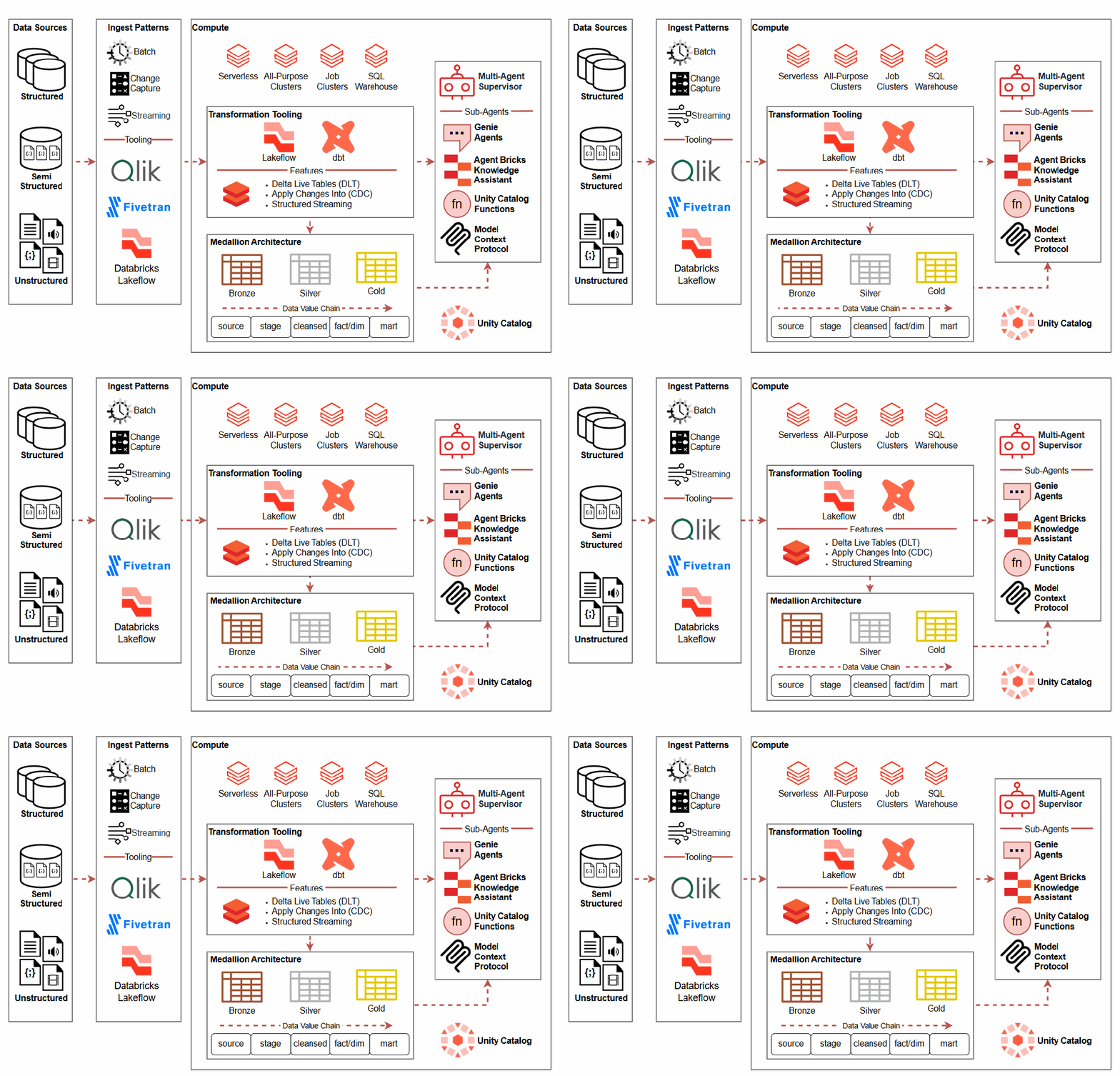
Sample Project Plans


Defining Success: A Multi-Dimensional Approach
The Four Levels of Data & AI Project Success
For example, too many organizations focus solely on technical metrics like model accuracy while ignoring whether the solution actually drives business value. Effective success measurement requires a multi-level approach:
1. Business Impact Metrics These are your north stars—ROI, cost savings, revenue increases, and efficiency gains. If you can’t connect your Data and AI project to these outcomes, question whether it’s worth pursuing.
2. Technical Performance Metrics Accuracy, precision, recall, latency, and scalability matter, but only in service of business objectives. A 95% accurate model that takes too long to provide insights may be less valuable than an 85% accurate model with real-time results.
3. Process Metrics How has your AI solution improved operational processes? Time-to-insight, data quality improvements, and automation rates often provide the clearest evidence of project impact.
4. Adoption Metrics The most sophisticated AI solution is worthless if people don’t use it. Track user engagement, system utilization, and stakeholder satisfaction as leading indicators of long-term success.
Leading Indicators: Your Early Warning System
Don’t wait until the end of your project to measure success. Establish leading indicators that predict whether you’re on track:
- Data quality trends: Are your data preparation efforts improving dataset reliability?
- Model performance trajectories: Is accuracy improving with each iteration, or have you plateaued?
- Stakeholder engagement levels: Are business users actively participating in requirements gathering and testing?
- Technical debt accumulation: Are you building sustainable solutions or creating maintenance nightmares?
Create real-time dashboards that make these indicators visible to your team and stakeholders. Transparency builds trust and enables course correction before small issues become major problems.
From Planning to Practice: Implementation Tools
Milestone-Driven Communication
Tie your communication plans to specific, measurable deliverables. Instead of weekly status meetings that discuss progress in abstract terms, schedule stakeholder updates around concrete milestones:
- “Data quality assessment complete with recommendations”
- “Proof-of-concept model achieving 85% accuracy benchmark”
- “Pilot deployment serving 100 users with <2 second response time”
This approach keeps everyone focused on outcomes rather than activities.
Resource Planning for the Long Haul
Data and AI projects don’t end at deployment—they evolve. Your resource planning must account for:
- Data Quality: Who will resolve source system data issues?
- Compute and storage scaling: How will resource needs change as data volumes grow?
- Model maintenance cycles: Who will retrain models and how often?
- Personnel evolution: As projects mature, skillset requirements shift from experimentation to operations
Budget allocation should reflect the reality that AI projects often require higher upfront investment in discovery and proof-of-concept phases, with costs decreasing (but not disappearing) in production.
The Bottom Line: Execution Excellence Through Clear Expectations
The most innovative Data and AI solution won’t succeed without solid project fundamentals. By establishing clear timelines with realistic buffers, defining multi-dimensional success metrics, and building in regular checkpoints for course correction, you create the foundation for transformative results.
Remember: the goal isn’t to predict the future perfectly—it’s to create a framework flexible enough to adapt when reality inevitably differs from your initial assumptions, while maintaining focus on measurable business outcomes.
Your stakeholders will thank you for the clarity, your team will appreciate the realistic expectations, and your organization will benefit from Data and AI initiatives that actually deliver on their promise.

 Ross McNeely
Leave a comment