
Modern organizations manage increasingly complex data ecosystems with diverse sources, schemas, and usage patterns. Microsoft Fabric Data Agents address this complexity by serving as intermediaries between users and data sources, but effective implementation requires careful consideration of instruction strategies.
Updated article on including Source and Global Instructions: Fabric Data Agent: Structured and Unstructured Data – Ross McNeely
This article examines the role of Data Source Agent Instructions and how they complement existing Global Agent Instructions to improve data query accuracy and efficiency for analytical conversations.
Comparison of legacy and new instruction options

The Current State of Agent Instructions
Global Agent Instructions have traditionally provided baseline guidance applicable across all data sources within a Fabric Data Agent. These instructions establish universal standards such as naming conventions, general query guidelines, and cross-source business rules.
However, as data environments become more heterogeneous, a one-size-fits-all approach presents limitations. Different data sources often require distinct handling approaches based on their unique characteristics, business contexts, and optimal query patterns.
Single Agent Instructions (Legacy)
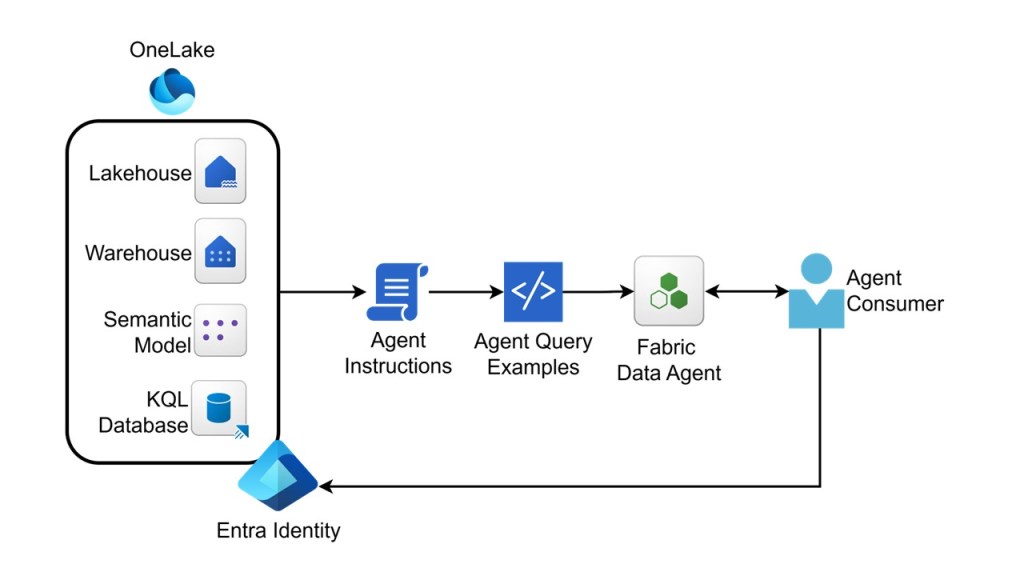
What Are Data Source Agent Instructions?
Data Source Agent Instructions represent a more granular approach to agent guidance, allowing Data Engineers to define specific instructions tailored to individual data sources. This approach recognizes that each data source used in a Fabric Data Agent may have different:
- Schema structures and relationships
- Business rule implementations
- Common query patterns
- Performance optimization requirements
- Contextual usage scenarios
Source Agent Instructions and Global Agent Instructions

Key Functional Benefits
Enhanced Query Precision
Data Source Agent Instructions enable more targeted query execution by establishing source-specific table priorities and relevant filters. This approach allows Data Agents to make informed decisions about table selection, join strategies, and filter applications based on the characteristics of each data source.
Improved Schema Utilization
By providing detailed guidance on when and how to use specific tables and columns, these instructions help Data Agents navigate complex schemas more effectively. This includes understanding table relationships, identifying primary use cases for different data elements, and recognizing when certain data should be excluded from queries.
Contextual Query Optimization
Source-specific instructions can include information about typical question patterns and high-value queries for each data source. This contextual information helps Data Agents understand not just the structure of the data, but also its intended applications and business significance.
Consistent Terminology Management
Data Source Agent Instructions help maintain consistent vocabulary by aligning Data Agent behavior with source-specific schema labels and business terminology. This reduces ambiguity in query interpretation and results presentation.
Structured Knowledge Transfer
These instructions serve as documentation that captures institutional knowledge about each data source, including best practices for data access, common pitfalls to avoid, and optimal approaches for different types of analysis.
Integration with Global Standards
Data Source Agent Instructions work alongside Global Agent Instructions rather than replacing them. This creates a hierarchical guidance system where global standards provide the foundation while source-specific instructions address particular requirements and exceptions.

Implementation Considerations
Clarity in Specification
Effective Data Source Agent Instructions require clear definition of use cases and constraints. For example, specifying “Use the Sales_Transactions table for direct sales reporting; exclude for returns analysis” provides unambiguous guidance for agent decision-making.
Schema Alignment
Instructions should use terminology consistent with the actual schema implementation to avoid confusion. This includes matching field names, table references, and business terms as they appear in the data source.
Contextual Documentation
Including examples of typical questions, common filter values, and business requirements helps agents understand the practical applications of the data source beyond its technical structure.
Technical Architecture
The dual-layer approach combines broad organizational policies with source-specific optimizations. Global Agent Instructions establish baseline behaviors and standards, while Data Source Agent Instructions provide the detailed guidance needed for effective interaction with individual data sources.
This architecture supports scalability by allowing organizations to maintain consistent overall data practices while accommodating the specific requirements of diverse data sources.
Operational Impact
Organizations implementing Data Source Agent Instructions typically observe improvements in:
- Query response times due to more efficient table and join selection
- Result accuracy through better understanding of data context and appropriate usage scenarios
- User experience consistency through standardized terminology and predictable behavior patterns
- Knowledge retention as best practices become codified in the instruction sets
Conclusion
Data Source Agent Instructions represent an evolution in Fabric Data Agent architecture that addresses the practical challenges of managing diverse data environments. By providing granular control while maintaining integration with global standards, this approach enables more effective analytical conversations at scale.
The implementation of source-specific instructions requires careful planning and clear documentation, but the resulting improvements in query efficiency and result accuracy can provide significant operational benefits for organizations with complex data ecosystems.
 Ross McNeely
Leave a comment