
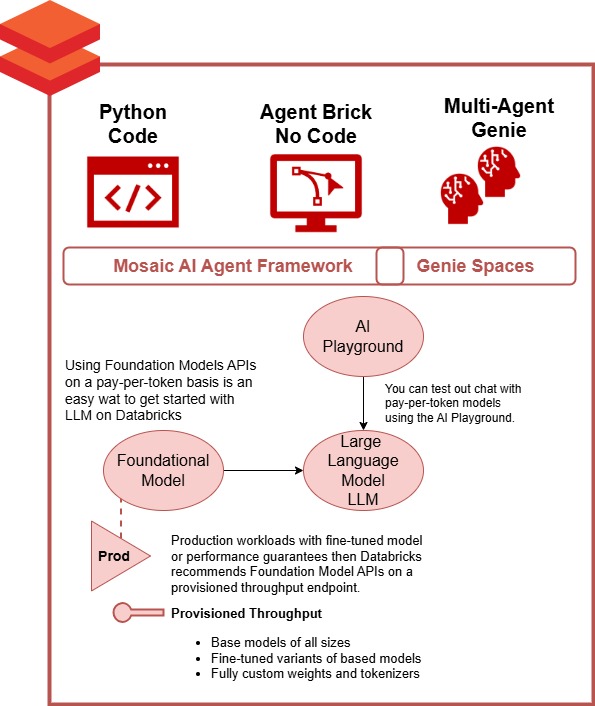
Code, No Code, Multi-Agent
Databricks provides the Mosaic AI Framework as a platform for developing AI solutions through a variety of interfaces, catering to different levels of expertise and project requirements. With options for coding, no-code workflows, and the innovative Multi-Agent Genie approach for data domains, Databricks empowers developers, data scientists, and business professionals alike to craft intelligent, scalable solutions.
Code-Based Development
The code interface is ideal for developers and data scientists who prefer granular control over their applications. It allows users to write custom scripts, utilize Python libraries, and leverage Databricks’ rich development ecosystem to create sophisticated AI solutions tailored to specific needs. Coding enables flexibility and precision, making it the go-to approach for complex and unique scenarios.
No-Code Interface Agent Bricks
For users who lack programming expertise or wish to accelerate development, Databricks offers no-code interfaces. These include drag-and-drop workflows, preconfigured templates, and guided tools that simplify the process of creating AI applications. With intuitive designs and automation, no-code interfaces lower the barrier to entry and empower business professionals to engage meaningfully with AI-driven solutions.
Multi-Agent Genie
The Multi-Agent Genie represents a cutting-edge approach to AI development by enabling collaborative multi-agent Genie for data domains. This interface leverages advanced models to create agents that interact dynamically, solving complex data domains through distributed intelligence. With Multi-Agent Genie, developers can craft applications that simulate human-like conversational analytics and decision-making, enhancing productivity and innovation.
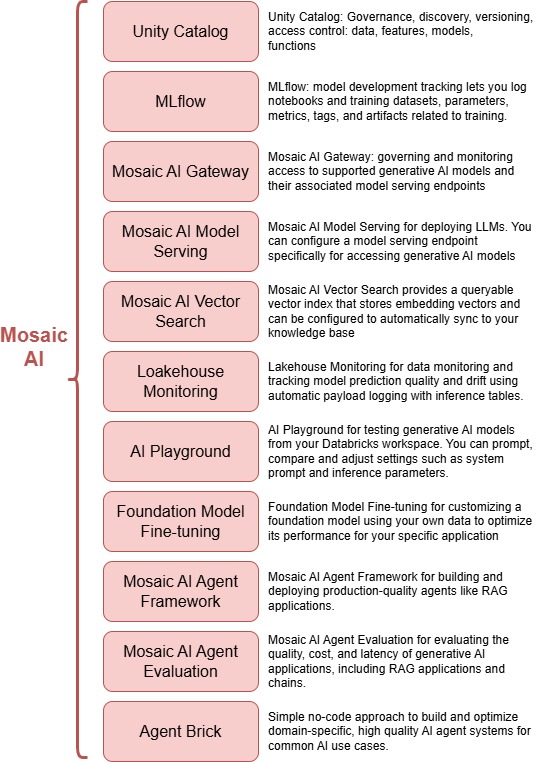
Benefits of Mosaic AI Agent Framework
The Mosaic AI Agent Framework is a cornerstone for building and deploying production-quality agents, particularly in applications like RAG (Retrieval-Augmented Generation). This framework offers several benefits:
- Scalability: The framework supports robust architecture designs, enabling developers to build applications that can handle increasing complexity and demand.
- Efficiency: Mosaic AI streamlines the development process through prebuilt modules and integrations, reducing time to market for AI solutions.
- Adaptability: Developers can customize agents to meet diverse requirements while ensuring compatibility with various data sources and environments.
- Production-Quality Standards: The framework facilitates high-quality deployments for applications such as RAG, ensuring reliability and responsiveness in real-world operations.
In RAG applications, the Mosaic AI Agent Framework enables effective retrieval of contextually relevant information while maintaining user engagement through seamless interactions with generative models.
Evaluating AI Applications: Mosaic AI Agent Evaluation
Mosaic AI Agent Evaluation is an essential tool for assessing the quality, cost, and latency of generative AI applications, including RAG and other chain-based systems. By providing detailed metrics and insights, it empowers developers and organizations to optimize their solutions effectively. Key aspects include:
- Quality Assessment: Mosaic AI evaluates the accuracy, coherence, and relevance of generative outputs, ensuring the application performs as expected.
- Cost Optimization: Developers can analyze resource consumption and identify areas to reduce operational expenses while maintaining performance.
- Latency Analysis: The evaluation tools measure response times and identify bottlenecks, helping teams improve application speed and user experience.
By combining these evaluation capabilities, Mosaic AI ensures that RAG applications and generative AI chains are not only functional but also efficient and scalable in production environments.
 Ross McNeely
Leave a comment