Insurer | Underwriting | Policy | Contract | Agent
Object Role Modeling (ORM) is a conceptual approach to database design that prioritizes simplicity and accessibility, allowing non-technical users to understand and interact with the application’s structure. As illustrated in the context of Insurer-Underwriting-Policy-Agent-Contract relationships, ORM captures intricate business rules by structuring associations such that key identifiers like Underwriting and Contract are derived from unique combinations of roles within their populations. These combinations ensure clarity and prevent duplication, making ORM an effective method for modeling complex relationships and validating data integrity. ORM’s ability to accommodate evolving requirements and deliver user-friendly models makes it a preferred choice over traditional data modeling approaches for dynamic business environments.
ORM Diagram: Insurer | Underwriting | Policy | Contract | Agent
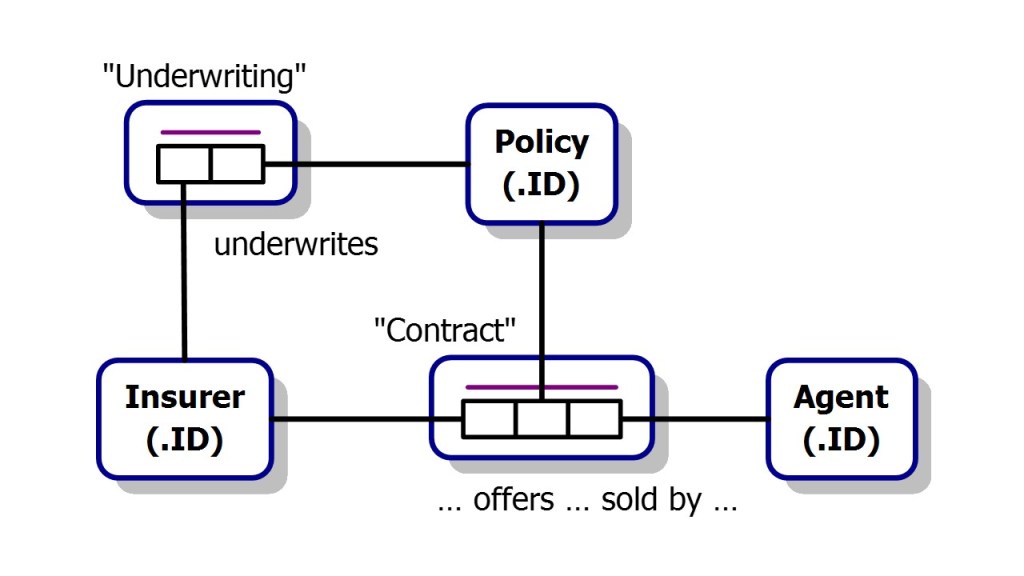
ORM Description: Insurer | Underwriting | Policy | Contract | Agent
An Insurer is responsible for underwriting Policies. Certain Insurers may underwrite multiple Policies, while a single Policy may have more than one Insurer underwriting it. Each pairing of Insurer and Policy is unique within the population of underwriting activities. This relationship forms the basis for identifying Underwriting in a structured and preferred manner.
An Insurer offers a Policy that is sold by an Agent. For some Insurers and Policies, an Insurer may offer the same Policy through multiple Agents. Similarly, an Insurer may offer multiple Policies through a single Agent, and for certain Policies and Agents, more than one Insurer may offer that Policy through the same Agent. Within the population of Insurer, Policy, and Agent associations, each combination of Insurer, Policy, and Agent appears no more than once. This structured relationship between Insurer, Policy, and Agent establishes the preferred method for identifying a Contract.
ORM Verbiage: Insurer | Underwriting | Policy | Contract | Agent
Insurer underwrites Policy.
It is possible that some Insurer underwrites more than one Policy and that for some Policy, more than one Insurer underwrites that Policy. In each population of Insurer underwrites Policy, each Insurer, Policy combination occurs at most once. This association with Insurer, Policy provides the preferred identification scheme for Underwriting.
Insurer offers Policy sold by Agent.
It is possible that for some Insurer and Policy, that Insurer offers that Policy sold by more than one Agent and that for some Insurer and Agent, that Insurer offers more than one Policy sold by that Agent and that for some Policy and Agent, more than one Insurer offers that Policy sold by that Agent. In each population of Insurer offers Policy sold by Agent, each Insurer, Policy, Agent combination occurs at most once. This association with Insurer, Policy, Agent provides the preferred identification scheme for Contract.
 Ross McNeely
Leave a comment