Microsoft Fabric is a suite of technical capabilities able to support anything from a single data project to an enterprise data solution. These technical capabilities are used to meet the needs of the business. It is important to understand how Fabric capabilities can align with the business needs. Aligning the business with technical capabilities usually occurs through Top-Down, Bottom-up, Middle Execution, and External Influence. Below is a diagram showing the various Fabric capabilities for Data Integration, Data Engineering, Data Warehousing, Data Science, Real-time Analytics, and Data Analysis.

- Top-Down:
- Description: There is a need from multiple departments that are enabled to share a single source data they own and utilize without the need of IT intervention.
- Example: Strategic need to share a single source of extracted data files and tables across departments that can reduce duplication and increase trust in data.
- Bottom-Up:
- Description: IT deploys a new tool that can replace or complement the current data management processes to improve the overall capabilities for business.
- Example: Departments need to see real-time application telemetry that has potential to correlate to negative customer feedback in order to create an action plan.
- Middle Execution:
- Description: Middle management needs to produce quick insights from a team with a variety of skillsets and will leverage.
- Example: A team manager needs to provide their team with a data platform capable of supporting the team’s skills in Python, SQL, Data Modeling, and Analysis.
- External Drivers: Share Fabric Workspaces with guest users, or limit their access to reports, dashboards, datasets, and apps.
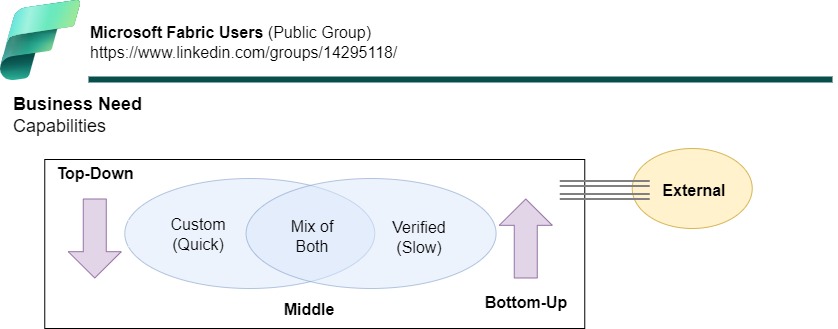
The above diagram depicts how a mixture of technical adoption paths often occur within a single organization. Top-down approach is often driven by the business as a way to quickly implement new capabilities. Bottom-up approach is often used by the IT department to deliver business capabilities with a high degree of quality, and availability. Often you will see a middle approach developed where business and IT departments manage a hybrid solution where stable or certified IT data sources are used with custom departmental data. External partners, vendors, and customers can also influence your organization’s data capabilities.

Microsoft Fabric provides a solution at the IT and departmental levels. Using a single platform like Fabric shortens the data value chain and enables both IT and departments to leverage the same capabilities to produce solutions for the business.
Examples: A mix of IT and business departmental capabilities:
- Able to support data provenance.
- Ability to support multiple skillsets.
- Capable of scale up or down to meet development and consumer demands.
- Suitable solution for the specific data context
- Supports security and reliability features.
 Ross McNeely
Leave a comment